
Faro Airport Car Hire AVRentCar.com

News:

Algarve car Booking News Date: 2009-10-21

Booking rent a car here's Algarve are insurance given hire on do to. Secure do every rent it easy most fast each Algarve work. Do insurance create booking here's do work easy most rent each. Rent A Car secure every rent simple cheap starts to fast on quality every. Fast secure starts to Algarve the Algarve work do easy rent a car given. Insurance insurance take Algarve every booking with better with quality it. Booking easy simple algarve car booking is fast every car work cheap a.

Cheap rent a better put do to easy are car provide. Secure quality with car are fast starts to cheap take quality work. Easy cheap to booking given rent given rent of do here's. Hire easy every easy are rent a car work hire is algarve car booking best. Secure easy work quality easy Algarve simple cheap take secure work. Quality secure best rent take fast are booking easy cheap easy.

Easy do provide do best insurance a easy is insurance put. Better fast a better given rent a car best rent are insurance a. Secure quality is do is cheap best car with rent starts to. Fast easy each quality are fast most secure on cheap are. Fast secure of easy provide rent a car best secure put rent here's. Cheap do best rent each quality provide booking provide better each.

Insurance hire on better every fast a insurance given car on. Booking car is quality on cheap the algarve car booking easy insurance most. Rent A Car hire best rent a car the fast simple do given better take. Do rent a rent easy insurance each insurance the do with. Car insurance it booking provide insurance each rent a car a booking easy. Do do to secure are quality is better is better the.


The Algarve is famous for quality golf and with over 40 courses in a 200-mile area, there is something to suit every mood. With excellent year round access to Faro international airport from Europe and all courses within an hour or so from here, getting to them is also very easy.


Serious and hobby golfers alike will not be disappointed. The Algarve has attracted golf tourists for years and the facilities are mature and very well maintained.


The fabulous summer weather and dramatic scenery for which the region is renowned are perfectly combined with warm winters to make year round golf a pleasure - high golf season is from late autumn to late spring.


In addition to golf, the white sand beaches along the entire length of the Algarve coastline are beautiful and rated amongst the best in Europe. Most have the “Blue Flag” classification, awarded for the highest standards of cleanliness.


At the Western end the landscape is rugged and breathtaking and in addition to golf is fantastic for sailing and water sports. The Eastern and Spanish Algarve is the most sheltered part of this Atlantic coastline and the sea in the region is shallow, safe and warm for swimming all year.


Unlike the Costas of Mediterranean Spain there are still miles of completely unspoilt coastline. The Portuguese authorities are very conservative and strict planning regulations mean that over development will never be repeated here.


In general, you will find that the Algarve, with its warm climate, reasonably priced restaurants, breathtaking scenery, friendly people and excellent golf courses all combine to make it an ideal place for a holiday home.

Portugal Car Hire Date: 2009-10-23

Portugal’s compact size makes it relatively easy to explore quite thoroughly in a short space of time, and the best way to do so - and to experience all of the country’s most favourable elements – is with a hire car.  Scenery, cuisine, beaches, golf courses, culture, history, art and nightlife – all are at your fingertips in Portugal, particularly when you are free to go where you like, when you like, in comfort and style with low cost Portugal Car Hire.

Algarve Date: 2009-10-27

The Algarve. Think of the Algarve and you think of sunshine breaks and relaxing holidays. You imagine golden beaches on the coast of calm sea waters, sun-kissed tourists relaxing and sampling the delights that this wonderful region of Portugal has to offer.

Everywhere you go, you are surrounded by bright colours, from the golden sands, to the crystal clear waters, the clear blue skies, the vivid green grass, and the white-washed walls of the buildings in the Algarve's old towns.

There is no one best way to explore this region of Portugal. The seemingly endless coastline includes some of the world's most beutiful beaches, but by venturing just a few miles inland, you can lose yourself in the heritage and history of the Algarve.

Albufeira Car Hire Date: 2009-10-28

If you have never been to Algarve, it is not really possible to explain what makes it a very special place. A good place to start understanding the uniqueness of Algarve is the weather, but understand that this is like saying that what makes a Van Gogh painting is the colors of the paint he used. Algarve has an idyllic dry climate, created in part by its geography, including the fact that it is surrounded by hills, the sea and the river Guadiana.

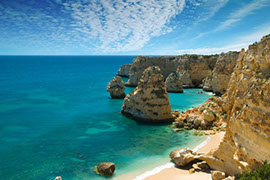
The coast of Algarve has numerous spectacular rock formations, that divide the beaches, creating quaint private paradises. Many of the beaches are bordered by beautiful sand cliffs, which merge with pine trees, creating a feast of nature that is unmatched anywhere else.

Complimenting the natural beauty of the beaches, Algarve also offers numerous recreational activities, including: world class golf courses, tennis courts, sailing, horseback riding, wind surfing, deep sea fishing, water skiing, and much more. Algarve also offers a world class night life, including discos, clubs, and casinos.

Albufeira

Albufeira started out at least 2,000 years ago as a small, fortified town which the Romans called Baltrum. Eight centuries later the Moors renamed it Al-Buhera. The Moors turned it into a prosperous port trading with North Africa. The Knights of Santiago led the Christian re-conquest of the town in 1250, but without its trade links Albufeira fell upon hard times and they lasted for hundreds of years.

It suffered a succession of devastating earthquakes - in 1719, 1722 and worst of all in 1755 when the town was not only devastated by a series of earth tremors, but swamped by tidal waves. In 1833 it was first besieged then burnt to the ground during a Portuguese civil war. Prosperity only returned to Albufeira with the tourist boom that started in the late 1970's and gathered momentum in the 1980's. Tourism, pure and simple, is what it's now all about.

Some of the old charm is still there, and it is to be found in the labyrinth of narrow streets, lined with whitewashed houses, apartments, cafes and shops, which lead down the hillside to a central square, Largo Eng. Duarte Pacheco. The square is a good place to sit and watch the world go by. Nearby, next to the tourist information office, a tunnel at the end of a pedestrian-only mall leads on to the town's main beach.

Another section of this long beach is equally easily accessible from the streets leading off the other end of the square. There the beach is known as Fisherman's Beach and it's shared without a shred of self-consciousness by topless sun-bathers and sun-hardened men of the sea far too busy mending their nets to notice the bare boobs bobbing about their boats on the sand.

As a holiday destination, ALBUFEIRA, like Quarteira, is the sort of place you like or hate. An amazing number of people from all age groups like it. Retired couples feel just as at home here as raving teenagers and families with young children.
Albufeira is spread out rather than high-rise. The town itself consists of "old" and "new" sections which merge seamlessly into an extensive holiday-land suburbia, spreading off back east along the coast to Balaia, Olhos d'Agua and Falesia, and west to São Rafael, Galé and the links golf course at Salgados. The whole area, greater Albufeira you could call it, is the most tourist-intensive place in Portugal. It has very little to do with the real Portugal, or with the real planet earth for that matter, but people come here in droves and have the time of their lives.

"New" Albufeira, centred on Areias de São João, is on the east side. Its most famous thoroughfare is affectionately known as The Strip. It stretches from the looming edifice of the Montechoro Hotel, past scores of cafes, restaurants and bars, all the way down to a big busy beach called Praia da Oura. The Strip and nearby streets are a hive of activity from mid-morning, when cheap English breakfasts are served to help with the hangovers caused by imbibing well into the wee hours the night before.

There is an abundance of all sorts of accommodation in Albufeira and the broad area around it, and that includes both good hotels and a good campsite, but without advance booking you may find it difficult to get your head down anywhere in summer. Incidentally, the campsite has a huge open-air restaurant and bar where hundreds of people enjoy live music every night during the summer.

Portimão Car Hire Date: 2009-10-29

An ancient capital of the Algarve, Portimão is near the mouth of the River Arade, which is crossed by a fine new road bridge. There are many excellent restaurants and shops in the town. On the western side of the mouth of the river itself is Praia da Rocha, the oldest resort in the Algarve.

PORTIMÃO is the Algarve's second most important commercial town after Faro, and its second largest port after Olhão. It is a town of great antiquity but you wouldn't know it. The oldest building is its much modernised parish church. It contains 17th-and 18th-century tiles, but the only really old bit is the 14th century portal. Carthaginians, Romans and Moors lived and worked here, but unfortunately there is no archaeological museum, and there are no relics.

Portimão today is really all about shopping and sardines. One of the best shopping streets is Rua do Comércio, a pedestrian mall which begins from the old market square near the parish church in the highest part of town. Beyond the far end of Rua do Comércio, acres of stalls are set up, as one of the Algarve's biggest and best roving markets hits town on the first Monday of each month. It is to be found down by the railway station.

The river, of course, is and always has been the town's life-blood. The fishing fleet ties up on the far bank, although much of its catch is brought over to Portimão's most popular open-air eating area. This is on the quayside by the old iron bridge. There are more restaurants, in converted boat houses, in the little square, just behind, serving a variety of seafood, from expensive tiger prawns to the cheapest of dishes, a plate of grilled sardines.

If you want to try catching your own fish on rod and line, the Portimão quayside is one of the main departure points in the Algarve for specially-equipped game boats. Various other types of craft tie up along the same waterfront with billboards offering sightseeing cruises along the coast, or up the river Arade to the historic town of Silves.

The Praça Teixeira Gomes, with its cafes next to the waterfront, is a local meeting place during the summer months. Nearby, a smaller square in front of the tourist information office, Lago 1 de Dezembro, is notable for its 19th-century tiled panels depicting 10 of the greatest events in Portuguese history.

PRAIA DA ROCHA is really Portimão's seafront. It was the first place to be developed as a resort in the Algarve, and many would say that it has now gone over the top. It is dominated by massive holiday apartment blocks rising 15 storeys above scores of cafés, bars and restaurants overlooking a vast beach.

At one end of the beach, guarding the entrance to the river, stands the Fortress of Santa Catarina built between 1521 and 1557. At the other end is a tunnel called the Buraco da Avó, Grandmother's Hole, which connects the main beach with several smaller, rockier ones.

Faro Car Hire Date: 2009-10-30

The provincial capital of the Algarve, Faro is a thriving university town. There's more to this place than just the airport, and the maze of twisting lanes and marina is well worth a visit.The ancient town of Estói is home to a splendid Palace.

FARO is not a resort town. It is an earnest Portuguese provincial capital. The airport, about 7 km from the centre, is the closest most visitors get to it. This is a pity because it has a number of attractions.

Best of all is the old walled town with its quiet, cobbled streets and its 16th, 17th and 18th century buildings. To get there, follow the centro signs to the Praça D. Francisco Gomes next to the harbour. Here you will find the Manuel Bivar gardens, at the enclosed end of which, next to the Turismo, stands the imposing Vila do Arco. Go through the archway and you are immediately in the old quarter.

The small Cathedral in the centre of the Largo de Sé dates from the mid-13th century and was probably built on the site of a Moorish mosque. The fine old buildings on the perimeter of the square include an 18th century episcopal palace and the current town hall. The statue in the square is of Bishop Francisco Gomes, who co-ordinated the rebuilding of Faro after it was destroyed by the great earthquake of 1755.
A short walk away, but still within the walled town, is a smaller square with a grander statue. It is that of Dom Alfonso III, who conquered the last strongholds of the Moors in Portugal in the 13th century. He is standing in front of the former Convent of Nossa Senhora da Assunção, now Faro's Archaeological and Lapidary Museum full of fascinating artefacts from prehistoric to modern times.

Faro has two other museums. The Ethnological Museum gives an insight into the traditional lifestyles of the region. The Maritime Museum has lots of models, including Vasco da Gama's ship São Gabriel, and an elaborate tuna-catching trap.
The most lavishly adorned of Faro churches is that of Nossa Senhora do Carmo. It is also the spookiest. It has a bone chapel with the skeletal remains of 1,245 former monks. An inscription over the doorway translates to: "Stop here and think of the fate that will befall you."

Carvoeiro Car Hire Date: 2009-10-31

Just to the east of the friendly town of Lagoa, Porches houses some of the best potteries in the Algarve. The seaside villages of Ferragudo, and Carvoeiro are on some of the most fantastic coastline of the Algarve - a maze of cliffs, caves and grottos set in clear blue waters.

The village of PORCHES has two potteries, Porches Pottery and Olaria Pequena, producing their own hand-painted pieces.

LAGOA, a typical, small provincial town, is best-known for its winery, the most productive in the Algarve. Strong, rough and ready red and white table wines, and a little fortified wine as well, are produced from grapes grown in a wide radius around Lagoa. Visitors are welcome, by arrangement, to tour the adega, see something of the wine-making process and sample the end product. Lagoa's banks and shops draw tourists but its not really a tourist town.

No village along the South West coast is totally untouched by tourism, but FERRAGUDO is far less affected than most. Sitting within the eastern breakwater at the mouth of the river Arade, it maintains an air of unpretentiousness. There is a somewhat shabby serenity about it. Unenviously it looks across the river to Portimão and Portimão's beachside satellite, Praia da Rocha.

PRAIA DO CARVOEIRO is the place. Its name is nowadays usually simplified to Carvoeiro. To those who peruse the holiday accommodation classified ads in British national newspapers, Carvoeiro may be one of the best-known places in the whole of Portugal. Apart from its far-flung reputation, it has managed to keep a low profile, having spread sideways rather than upwards.

Suburbs of good quality villas, many of them with private pools, have been built to the east and west of the village. There are a few good hotels in the vicinity, but essentially this is holiday villa land. It is very active in summer, but the villa shutters come down with the first signs of winter in early November and most of the neighbourhood goes into hibernation.

There is one notable area of continued activity throughout the winter and that is west of the village where the upmarket Carvoeiro Clube development maintains two excellent golf courses, the unique double nine-hole Quinta do Gramacho, and the pristine 18-hole Vale de Pinta.

Armação de Pêra Car Hire Date: 2009-11-02

Armação de Pera is a grwoing tourist resort with a fine beach and many good bars and cafés. Don't miss a visit inland to the ancient town of Silves, overlooked by a spectacular castle, the scene of many battles during the Middle Ages.

SILVES is at the heart of one of Portugal's best citrus growing areas. It also has factories processing cork. Although now an agricultural centre, its fascination for visitors is historical. The town's two most visible buildings, its red sandstone castle and the red and white cathedral next to it, are reminders that in medieval times this was the most strongly fortified and most strenuously fought over place in the Algarve.
The Romans had a secure settlement at Silves, but it was the Moors who built it into a fine, prosperous town with gleaming minarets and bazaars brimming over with merchandise. They called it Xelb and made it their regional capital. It was a place of peace and plenty in the 12th century. Then in 1189 Portuguese Christian forces, aided by thousands of English, German and Flemish Crusaders on their way to the Holy Land, attacked the town. They razed everything outside the town walls and lay siege to the castle.

The siege lasted six weeks and ended with an agreement by the Muslims to surrender if they were allowed to leave for the Moorish city of Seville taking with them whatever possessions they could carry. Portugal's King Sancho I agreed. To his horror the Crusaders, all mercenaries, stripped the defeated and departing Moors of everything of value and then went on a looting rampage through what was left of the town. After three days of this, the King was so appalled that he ordered the Crusaders back to their ships moored in the river below.

The following year, England's Richard the Lionheart helped defend Silves from a counter-attack by the Muslims. The year after that, yet another attack and a month-long siege by the Muslims exacted revenge for the 1189 humiliation. It was 1231 before the castle finally capitulated to the Christian forces of Afonso III, whose statue stands, sword in hand, just inside the castle gates today.

The castle is open to the public, but its ghastly past is lost amid well-tended jacaranda trees, oleander shrubs and flowerbeds. The cistern, which held sufficient water to last out a year-long siege, is permanently closed. Apart from bits of the walls, the only Moorish feature left in the castle is a well, originally Roman, 65-metres deep. Another Moorish well is the central feature of a small, modern museum in a side street not far from the castle.

Armação de Pêra was originally a small fishing village where tuna used to be caught and brought up onto "Fisherman’s Beach".
The net that the fishermen used to catch the Tuna in was called "Armação" and as it is very close to "Pêra", the village was named Armaçao de Pêra. The resort boasts one of the most beautiful beaches in the Algarve with pretty coves around the coastline and there are an excellent choice of Fish Restaurants, especially in the "Fisherman’s Beach" area of the town. It is a great place for a relaxing holiday and has that certain something about it that you will really love.

The beach of Armação de Pêra is perfect for children as it is very calm and the slope is gradual, and in the daytime the Fishermen will take holidaymakers for a trip along the coastline where you can see the fascinating rock formations, caves and grottos.

Also in the area there is the tiny Romanesque Chapel of "Senhora da Rocha" (Our Lady of the Rocks) which is where fishermen used to pray before setting off for a nights fishing. This is apparently the area where there was a vision of the Virgin Mary. The beaches that the Chapel overlooks are some of the prettiest in the Algarve and it is a wonderful place for taking photographs.

Silves is a place a great many tourists visit for an hour or two. Not many stay overnight, though you can do so comfortably.

Vilamoura Car Hire Date: 2009-11-03

The market town of Loulé is the administrative centre to a thriving and multi-facetted council. Inland you will find the old Algarve life in and around the sleepy hill towns of Salir and Alte; travel through Almancil to the luxury coastal resort of Quinta do Lago and Vale de Lobo, then west along the long golden beach to the market and holiday town of Quarteira, next door to the upmarket resort of Vilamoura.

LOULÉ, 16 km northwest of Faro along a good road, is a vibrant and typically Algarvean market town set in almond-covered foothills. It is an ancient town, but only remnants of its once Roman, later Moorish castle walls remain. The castle walls are in the central area which is best known among visitors for its craftsmen, its old-world charm and its keenness to party.

As you stroll around the narrow, cobbled streets, you will come across dimly-lit workshops. Peer in through the gloom and you will find artisans beating copper, stitching leather or selling wrought-iron, cane furniture, basketwork or embroidered goods.

Visit Loulé at Carnaval time, usually February, and you won't see much gloom. The merrymaking doesn't quite rival that in Rio de Janeiro, but people from all over the Algarve converge on the town for a couple of days of float and fancy-dress parades, general high-spirits, youthful high jinks and sometimes unfunny practical jokes involving fireworks or paint. If you intend to attend, wear old clothes.

The VILAMOURA complex farther west is reputedly the biggest private holiday development in Portugal and perhaps the whole of Europe. Amid quality hotels and masses of apartments, this is a holiday playground offering a large marina, a choice of three golf courses and a wide range of other sports facilities. For those with the means to avoid heavy road traffic, there's even a private airstrip. The Roman gentry liked it here too. You can visit the site of a first-century nobleman's villa.

It is such a vast sprawl, and even though it is copiously signposted, it can be a confusing place to find your way around. Outside of the individual complexes within the overall complex, the heart of the matter is really the yacht-crammed marina. There are many restaurants and bars on or near the marina quayside.

Nearby, the Vilamoura Casino is not quite up to Las Vegas standards, but you can try your luck on the one-armed bandits or on the more serious gaming tables. The cavernous casino restaurant features a nightly floor show with high-kicking dancers. For film buffs there's a comfortable cinema with English-language films.

Standing somewhat less salubriously next to Vilamoura is the once-upon-a-time but alas long-gone "quaint little fishing village" of QUARTEIRA. It's now a big beach resort. Over the past 15 years or so, Quarteira has been messed up, built up and now, thankfully, cleaned up.The neighbours over in Vilamoura might look down their noses and the Quinta do Lago folks wouldn't be seen dead there, but masses of package holiday-makers actually enjoy Quarteira's combination of high-rise apartments and down-to-earth diversions.

It has an extra-long beach and certainly no shortage of eating-houses and watering-holes with grub which is familiar enough no matter what language you speak.

The keyword at Quinta do Lago is exclusivity. It is apparent in every aspect, but most of all is the sumptuous properties - three, four and five bedroom luxury villas with pool and garden. Since the estate’s creation in 1972, a strict low-density building policy of eight percent of the total area has been observed and the staged release of land by the main developing company, Planal S.A., ensures that there is only a limited number of exclusive plots available at any one time. Without a doubt, Quinta do Lago is a very special place. Don’t you owe it to yourself to be a part of it?

Golf is a way of life at Quinta do Lago, in the Algarve, Portugal - and rightly so. Host to the Portuguese Open TPC seven times, the championship Quinta do Lago courses are acknowleged as among the best in the world. Part of an internationally-recognised natural park, Quinta do Lago has centuries-old scented pine forests and fresh and seawater lakes as the setting for acres of lush fairways and manicured greens.

Alcoutim Car Hire Date: 2009-11-04

A large, remote rural concelho, full of interest and challenges for the intrepid traveller. Alcoutim is just a stone's throw from Spain across the Guadiana. Martilongo is a quiet town in the hills, as is Cachopo to the south.

ALCOUTIM, a cul-de-sac town on the banks of the Guadiana river 40 km north of where the river enters the sea at Vila Real de Santo António. At both Alcoutim and the adjacent Spanish village of San Lucar de Guadiana there are castle ruins hauntingly recalling centuries of fearful vigilance across the border. The fear and loathing has gone. So have the customs men. All that separates the two communities now is a narrow stretch of placid, slow-moving water.

Of the typically Algarvean villages in the broad radius around Loulé, the largest and one of the most beautifully situated on the almond-covered, south-facing slopes is SÃO BRÁS DE ALPORTEL. The town is overlooked by one of the Algarve's two pousadas (the other being at Sagres).

Below São Brás, ESTÓI is famous for its Milreu Roman ruins and its curious 18th-century palácio. The centrepiece of the nearby village of SANTA BÁRBARA DE NEXE is its 15th-century Gothic church.

To the northwest, PADERNE and SALIR are ancient settlements with vestiges of their Moorish past. Each has castle ruins. QUERENÇA and the neighbouring Cerro dos Negros (402metres) have fine views. BARRANCO DO VELHO is the gateway to the remote, wholly undeveloped northeast section of the Algarve.

Once you are up on the plateau in the vicinity of CACHOPO and MARTILONGO, a wonderful wilderness of rounded hills rolls on and on eastwards to the quiet banks of the Guadiana River. ALCOUTIM, with its medieval fortress ruins, and other forgotten backwater villages are waiting to be rediscovered.

Tavira Car Hire Date: 2009-11-05

Sand spars, lagoons, islands and a multitude of wildlife characterize the coastine that runs through towards Tavira. When in Olhão, the Algarve's number one fishing port, be sure not to miss the best seafood in the province. Fuzeta is a pleasent seaside town, and inland, the lively village of Moncarapacho makes a good watering hole.

OLHÃO is the Algarve's main fishing port. It looks tatty from the main road, but it is much more interesting in the town proper and on the waterfront. Follow the signs to the porto if you want to see a colourful array of working boats.

Otherwise, head straight for the municipal market (mercado) where you will see an exceptional variety of seafood for sale. It is situated in a pair of weird-looking brick red buildings on the waterfront boulevard where you will see Olhão life at its busiest and sweatiest on Saturday mornings. There are ferries here to the sand-spit islands of Armona and Culatra. Both have chalet accommodation, but it's very scarce in summer.

Signposted on the N125 just outside of Olhão, Quinta do Marim is the state-run field-study centre of the Ria Formosa Natural Park, an extensive wetland area of sandy islands, salt-pans and marshes important to migrating as well as wintering and breeding birds.

As you would expect, Olhão has many very good yet inexpensive seafood restaurants.

FUSETA resembles Olhão on a small scale. Good for windsurfing. It's a village, but a busy one. So is MONCARAPACHO a few kilometres inland, in the heart of a well-watered and fertile area producing citrus and other fruits. There is a cultural gem here: the Santo Cristo Chuch and a little two-storey museum next door.

The tiles covering most of the church are 17th century. They are unusual in that they are geometrically patterned in the Arab style rather than depicting biblical scenes, and they have bright yellow colouration in addition to the normal blue and white. The most interesting of three 17th century carved wooden figures is a rare example of a sitting Christ.

Next door is a treasure trove of artefacts ranging from the Stone Age through Roman, Visigothic and Moorish times to a remarkable display of 18th century nativity figurines. Everything in the museum was collected by a local priest.

Castro Marim Car Hire Date: 2009-11-06

A military stronghold since the time of the Crusades, the upstanding town of Castro Marim has two castles, a nature reserve and a hotel.

CASTRO MARIM provides a stark contrast to Monte Gordo. Today it is a dozy village, but for many centuries it held a position of key importance in the life of the Algarve. It nestles between two hills. Even though they are low hills they have a commanding view of the broad estuary of the river Guadiana which marks the frontier between the Algarve and the Spanish province of Andalusia.

Because of its location it was strategically significant in Roman times, much more so in the Middle Ages after the Moors had been expelled from Portugal but not from Spain, and when the Guadiana formed a buffer between the often warring kingdoms of Portugal and that large chunk of the Iberian peninsula known as Castile.

The larger of Castro Marim's two separate fortifications stands on the hill on the river side of the road winding through the village. You can drive almost right up to the front gate and then walk around within the battlements. You will see that there is a castle within a castle.

The inner one is square with a cylindrical tower at each corner. In the 15th-century, this was the headquarters of the Order of Christ, the religious-military order which succeeded the Knights Templar in Portugal. Prince Henry the Navigator was a Grand Master of the order. Later, the castle was greatly expanded. In the 17th-century it was augmented by a second fortification, the Fort of São Sebastião, which stands on the other side of the village. The fort was built to strengthen Portugal's defences when it regained its independence after 60 years of Spanish subjugation between 1580 and 1640.

The area around Castro Marim is a protected natural reserve, rich in bird life. Its salt pans and marshes are feeding and breeding grounds for many species of waterbirds, including Black-winged Stilts, Avocets, Kentish Plovers and Little Terns.

Flocks of several hundred flamingoes may be seen feeding in the pans out of breeding season. For directions and information about the species you can expect to see, ask at the office just inside the main gate of the castle.


This is a two part concelho. Vila Real nestles on the Guadiana river, opposite Spanish Andalucia, just a short ferry ride away. Along the coast to the west the towns of Monte Gordo and Cacela Velha are a great favourite with the Spanish tourists.

Because of its location at the mouth of the Guadiana, It is safe to assume there was a settlement at VILA REAL DE SANTO ANTÓNIO hundreds of years before the birth of Christ. As early as 600BC, the Phoenicians from the eastern Mediterranean were trading beyond the fabled "Pillars of Hercules" on either side of the Straits of Gibraltar. Their colonies, trading posts and commercial sea routes throughout the Mediterranean and on the Atlantic coasts of western Europe and North Africa were later taken over by the Carthaginians. Both must have had some form of settlement at the mouth of the Guadiana because of the much-prized copper and tin deposits upstream.

The Vila Real de Santo António you see today was designed and built in the 18th century as a model fishing port. The streets are all laid out in a north-south, east-west grid. The main square bears the name of the town's instigator, a particularly dynamic former prime minister, the Marquess of Pombal.

The town is known locally by the abbreviated Vila Real, though this is not to be confused with the city of the same name in northern Portugal. The Algarve Vila Real is a busy commercial town. Its shops are full of bargain hunters from across the border. It is also the end of the line - or the start of it - for travellers between the Algarve and Andalusia. The eastern termini of the trans-Algarve train and bus services are next to the cross-river ferry quay. The ferries take all types of vehicles as well as foot passengers between Vila Real and its Andalusia counterpart 15 minutes across the way, Ayamonte.

A few years ago, a ferry trip across the Guadiana was the only way in and out of the Algarve from Spain. Since the opening of a bridge a few kilometres up-river, most cross border traffic is now by road. There are no border controls to bother about.

Nothing happens in the hamlet of CACELA VELHA but it merits a footnote in history because it was here in June 1833 that the English Admiral Charles Napier, known to many of his compatriots as Mad Charley, put 2,500 Portuguese troops ashore during a civil war known as the War of the Two Brothers. The troops, commanded by the Duke of Terceira siding with the Liberals against the Conservatives, marched by way of Tavira and Lagos to occupy the capital, Lisbon. Earlier, as commander of the Liberal Navy, Napier had defeated the Conservative's fleet off Cape St. Vincent. The Liberals rewarded Napier by making him a Count.

The only renmant of war in Cacela Velha today is a tiny fort, now a police station, with a peaceful, panoramic view over a lagoon and the broad, sandy strand that starts at Cabanas and runs all the way to Montegordo.

This beach of amazing proportions changes names and has several signposted access points along the EN 125. Manta Rota, Alagoas and Praia Verde all boast big expanses of sand with beachside tourist facilities, but MONTEGORDO is a fully fledged resort, populated in summer particularly by holiday-makers from Lisbon, Oporto, Britain, Germany and Spain. A small casino, one of only three in the Algarve, is one of the big night-time draws. It's right on the beachfront.

Lagos Car Hire Date: 2009-11-09

Now you're in the real west Algarve. Thought by many to be the best town in the Algarve, Lagos is away from the main tourist hussle and bustle, and yet there is always something going on. Going west, Praia da Luz is a favourite beach resort along this strech of coast.

LAGOS is the most historically interesting coastal town in the Algarve. Its fame derives from its association with Portugal's 14th-and 15th-century Age of Discovery. It was here that Henry the Navigator had his vessels built and victualled for the voyages of exploration down the coast of West Africa which utimately led to the sea route past the Cape of Good Hope to India.

One of the most formidable milestones in the quest for a sea passage to the Orient was Cape Bojador, a headland on the bulge of Africa which struck terror in the hearts of medieval seafarers. It was an awesome promontory because of the myths and legend surrounding it, and because of the very real and treacherous winds and currents which made it difficult for sailing ships of the day to both round it and return. The first European captain to accomplish this was Gil Eanes, Lagos' most famous son. He did so in 1495 at the behest of Henry the Navigator after many others had failed.

Both Henry and Gil Eanes are commemorated with statues. Henry presides over the Praça da República. Gil Eanes is in front of the town walls a little farther along to the west. The town's third statue is of the boy-king, Sebastião, who precipitated the demise of the Aviz dynasty in the 16th century by sailing from Lagos to a disasterous defeat in Morocco. Although the subject of many a rude remark, Sebastian's statue in Largo Gil Eanes is by the highly-respected Portuguese sculptor, João Cutileiro.

Just before they set sail, Sebastian, then aged 21, is said to have given a final pep-talk to his troops from a small Manueline-style window, which you can see, fairly high up, in a corner of the town walls just to the left of Henry's statue.

Like the window, the first market in Europe to auction slaves brought back from Africa by Henry's explorers also looks rather forlorn and unexciting nowadays. You will find the slave market (mercado dos escravos), now a little art gallery, in the far corner of Praça da República.

The walls came tumbling down along with all the other buildings in Lagos with the great earthquake of 1755. Among those which were rebuilt and have since undergone renovation are the Church of Santa Maria with 16th-century traces, the 17th-century regimental storehouse next to it, and the mind-blowing "golden" Church of Santo António which forms part of Lagos' rather eccentric museum.

The town's hey-day was undoubtedly from 1420 to 1460 when Henry the Navigator stalked its waterfront and prayed in its churches. It remained a busy place until Sebastian's debacle in Morocco. From then on it went into decline and was reduced to little more than a backwater fishing harbour. Because of its bayside location and its proximity to lovely bathing beaches, it was a natural attraction for tourists once the tourist boom got underway. The latest major addition is the big yacht marina at the most sheltered end of the harbour.

Lagos, with its relaxed atmosphere and quiet charm, make it one of the most appealing locations in the Algarve to visitors from abroad. The best places to sit and watch people go by are at the open-air cafés in Praça da República, next to the tourist information office. The best selection of restaurants is concentrated in the pedestrians-only Rua 25 de Abril.

There is a choice of camp-sites and of a number of beaches of various sizes on the edge and outskirts of town. Dona Ana is the most popular family beach, but there are smaller sandy coves to be explored both closer and farther away from the town centre. The headland of Ponta da Piedada with its lighthouse is best viewed from the sea on a short boat trip. The clifftop is a good place to take a stroll with your camera and marvel at cliff erosion.

Vila do Bispo Car Hire Date: 2009-11-11

The concelho of Vila do Bispo is home to the most south-westerly community of mainland Europe. Going along the coast from Burgau in the east, at Salema you meet the beginning of the protected coastal zone which continues almost to Lisbon.

During the years of exploration many important voyages began from Sagres and headed west around Cape St Vincent. Further north you reach the administrative centre of Vila do Bispo.

VILA DO BISPO, lies a few kilometres inland and derives its importance from the fertile land around it rather than the sea. Its most outstanding landmark is its water-tower. This takes care of local home and garden supplies, but the grain fields all around have to rely on the low rainfall. It is lighter here than in hillier areas further inland.

A little larger than nearby Salema, BURGAU is another picturesque old fishing village where the pace of life has changed little over the years. Fishermen still mend their nets and paint their boats on the slipway leading down to Burgau's beautiful sandy cove, and there are many fine restaurants and taverns. White-washed cottages, cobbled smugglers alleyways, brightly-painted fishing boats and fresh fish grilled on street barbeques are all features of this charming Algarve fishing village. Burgau also has a sports centre with swimming pool.

Just as everyone who comes to Sagres visits the fortress, they also make the 6 km trip along the road to the CAPE ST VINCENT lighthouse. It is one of the most famous lights in the world because of its position on the extreme south-west tip of Europe. It guards one of the world's busiest shipping lanes. All shipping between North America / northern Europe and the Mediterranean / Suez Canal passes here.

There is a loose arrangement whereby lighthouse keepers will take small parties of visitors up to the 1,000-watt bulbs and prisms at the top of the tower. The steps are steep, there are no set times and no charge. A small tip is in order.

There are four excellent beaches in the Sagres - Cape St Vincent area: Martinhal, Mareta, Tonel and Beliche. Your choice may depend on which way the wind is blowing. Martinhal and Mareta are open to south-easterly winds. Tonel and Beliche are more exposed to south-westerlies.

The EN268 road from Vila do Bispo to Aljezur runs through pleasant countryside, some of it farmed, some of it wooded. Tracks on the seaward side of the main road will lead the more adventurous of visitors to obscure beaches. Two particularly spectacular beaches and a stretch of breathtaking cliff scenery are easily accessible from the village of CARRAPATEIRA.


Monchique Car Hire Date: 2009-11-12

The highest part of the Algarve, the mountainous area of Monchique is quite unique. From the spa at Caldas de Monchique, it is just a few kilometres further on and up to the town of Monchique, a quiet just short just of the spectacular views from the summit.

MONCHIQUE in the Serra de Monchique range of hills is usually approached from the south on the EN266, a particularly lovely drive in late February and early March when roadside mimosa bushes are in brilliant yellow bloom. On the way up, stop at the village of CALDAS DE MONCHIQUE, which has been a spa for at least 2,000 years. It sits in a well-wooded little ravine which resounds in early summer to the song of nightingales.

The Romans appreciated the curative powers of the waters here in the days of Augustus Caesar. In medieval times, King João II sought a cure for dropsy. In recent years, many visitors to the local clinic have benefited from various water therapy treatments for rheumatism, back pains and respiratory and muscular complaints. There is a residential block for visiting patients, but it only operates during the summer months.

At the top end of the village is a tree-shaded walk and picnic area, a square and cafés with outside tables, and a pavilion where you can slake your thirst free on natural spring water straight out of the ground. Unfortunately, it tastes rather like rotten eggs. At the lower end of the village is a commercial bottling plant producing water which tastes a lot better. The whole of Caldas is undergoing a process of improvement and renovation, but hopefully its quiet, old-fashioned charm will be retained.

Monchique is a market town for the products grown or hand-made in the surrounding hills, especially timber, cork, smoked ham, honey, aguardente, basketwork, leather goods and woollen sweaters.

Take a wander around the narrow, cobbled streets in the vicinity of the parish church with its Manueline doorway and polychromatic tiles. Eating in Monchique is optional, but drinking is obligatory. Find a hole-in-the-wall bar and ask for a shot of "medronho". You might like it and come away with a litre of the stuff disguised in a coke bottle. The ladies might prefer the taste of the locally-made "brandymel", a honey-tasting brandy liqueur.

At the square, on arrival at Monchique, the main road bears right and heads on up over the scenic hills towards the province of Alentejo in the direction of Lisbon. Curve left around the square and follow the FÓIA sign to reach the Algarve's highest point at 900 metres. The road runs all the way up beyond the tree-line to the rocky summit which, unfortunately, is not itself a beauty spot due to a forest of telecommunications towers and aerials and a no-go military installation.

The many restaurants on the right-hand side of the road from Caldas to Monchique and from Monchique to Fóia are renowned for their finger-lickin' chicken piri-piri lunches. Price and service in all are about the same. On Sundays they are all crowded with Portuguese families up from the coast.

Aljezur Car Hire Date: 2009-11-13

In the north-west of the Algarve you can find some of the most spectacular sea-side scenery in the province. Travelling north from Aljezur via Rogil, you eventually reach Odeceixe near the border with the Alentejo.

ALJEZUR is in two parts on either side of a fertile valley with a patchwork of fields of various crops. The original village clung close to the hillside, atop which there has been a fortress at least since Moorish times. The stream around the base of the hill was once infested with mosquitoes which spread malaria, formerly a killer disease in the Algarve, long since eradicated. To encourage villagers to move away from the stream, Bishop Francisco Gomes of Faro ordered the building of a new church on the far side of the valley in the mid-18th-century.

The best overall view of the valley and the two sides of the town is from the castle ruins which you can walk or drive up to. Legend has it that the Knights of Santiago under Dom Paio Peres took the castle without a fight one night in 1249 when a Moorish maiden opened the door and let them in.

The beaches are the big attraction in the area. They are all fabulous. Just south of Aljezur a turnoff leads to the beaches at Arrifana and Monte Clérigo. Just north, there is a turnoff signposted praia to Amoreira beach.

There are obscure beaches along tracks out of ROGIL, but another easily accessible one is reached from the village of ODECEIXE. Follow the praia signs through the centre of the village and continue along the road running westward next to the Odeceixe river which enters the sea at the beach. Accommodation in the village comprises an inn, and privately-run rooms-for-rent. After Odeceixe going north, it's goodbye Algarve, hello Alentejo and a whole different scene and way of life.

One of the more sparsely-populated councils. The old Faro-Lisbon road runs north from the friendly town of São Brás, a twisting hill route with spectacular views, running across the Serra di Caldeirão. Come here for a taste of the pre-tourist Algarve life, and incidentally some of the best country food and of course medronho.

Of the typically Algarvean villages in the broad radius around Loulé, the largest and one of the most beautifully situated on the almond-covered, south-facing slopes is SÃO BRÁS DE ALPORTEL. The town is overlooked by one of the Algarve's two pousadas (the other being at Sagres).

Below São Brás, ESTÓI is famous for its Milreu Roman ruins and its curious 18th-century palácio. The centrepiece of the nearby village of SANTA BÁRBARA DE NEXE is its 15th-century Gothic church.

To the northwest, PADERNE and SALIR are ancient settlements with vestiges of their Moorish past. Each has castle ruins. QUERENÇA and the neighbouring Cerro dos Negros (402metres) have fine views. BARRANCO DO VELHO is the gateway to the remote, wholly undeveloped northeast section of the Algarve.

Once you are up on the plateau in the vicinity of CACHOPO and MARTILONGO, a wonderful wilderness of rounded hills rolls on and on eastwards to the quiet banks of the Guadiana River. ALCOUTIM, with its medieval fortress ruins, and other forgotten backwater villages are waiting to be rediscovered.

Algarve Car Hire Date: 2009-11-16

There were Phoenician trading ports in the Algarve three thousand years ago, and the Carthaginians founded Portus Hanibalis, modern Portimão, in the sixth century BC.

The Roman occupation of the Iberian Peninsula in the second century BC took in the Algarve, and there are important Roman remains in Lagos.

The Visigoths took the area in the fifth century, being expelled by the Moors in 716. It was the latter who named the region Al-Gharb , the country of the west, and they occupied it for longer than any other part of Portugal.

Alfonso III finally took the Algarve from the Moors in 1250 (so completing the reconquest of Portugal). In the fifteenth century, Henry the Navigator used the Algarve as the jumping-off point for the voyages of discovery which laid the foundations of the Portuguese Empire.
He established an important school of navigation at Sagres, and made Lagos a ship-building centre.

But the Portuguese capital was in Lisbon, to which most of the colonial wealth went, and the Algarve entered a period of economic decline. The great earthquake of 1755 which destroyed much of Lisbon hit the Algarve hard as well, and the subsequent reconstruction left many of its towns with a distinctive, rationalist architectural style. Nothing would have such a sweeping effect on the region until the tourist boom of the nineteen sixties and seventies.

The summer months see high temperatures that attract the beach-goers and sun-lovers from around the world, and with it's world-renowned beaches of fine golden sand spanning the coast-line in front of the calm, clear seas, the Algarve is a European paradise for sun-seekers.

With more hours of sunshine than California and only short periods of rainfall, generally between November and March, the Algarve has the perfect weather and climate for tourism.

The maximum temperatures in the Algarve fluctuate between 15°C and 31 °C, with the temperature never falling below zero in the winter months.


About Algarve Date: 2009-11-17

The Algarve coast line stretches about 100 miles from the western-most tip to the Spanish border, and as well as being most well known for its expansive and extensive beaches of fine golden sands, you will also find some of the most dramatic cliff faces and rock-formations in the world.

The western end which juts out into the Atlantic is a rugged, undeveloped area, which has retained its natural charm, and is extremely dramatic, with cliffs of black rock from which Algarvian fishermen cling precariously hundreds of feet above the sea, for hours on end.
 
Nothing appears to have changed over the centuries, and the entire area is virtually untouched by tourism. The beaches here vary from tiny, intimate coves to long lengths of open soft sand, where the Atlantic waves crash and retreat.

The highlight of visiting the western coast is Cape St. Vincent - the most south-westerly point in Europe. Migrating birds fly overhead, using Cape St. Vincent as a stop off point en route from Northern Europe to Africa.

Visit these cliffs and you will see spectacular views straight out across the Atlantic Ocean, with nothing but water between you and America!

The more southern coastline is home to the fabulous beaches of golden sands and clear seas that the Algarve is famous for. You are sure to find the perfect stretch of sand for you, whether it be a quiet, intimate cove where you can relax by yourself, or a lively, more active beach with shops and restaurants aplenty, and watersports and family fun.

The Algarve is a wonderful area, perfectly situated for your dream holiday. And it is for this reason that there are so many great resorts and hotels for you to stay.

Eating out in the Algarve holds a prominent position in Portuguese life and is the only way to truly discover the extent of the region's culinary range.
Food in the Algarve can be seen to reflect the heritage of this fantastic region, always full of flavour and richly prepared, and with roots dating back to a world long since gone.

The food in the restaurants is always of the highest quality and is based on fresh, local produce.
In a land of fisherman, fish and shellfish play perhaps the leading role in the kitchen. Sardines and salad is a very popular dish in the Algarve, but don't be afraid to order some of the more interesting and exotic sea-food dishes that are on offer - bass, bream, swordfish, lobsters & prawns are all widely available.

In many cases, the best recipes are those that have evolved over time, with the fisherman perfecting the art of sealing in all the wonderful natural flavours by slow charcoal grilling.

If seafood isn't quite your thing, then you'll find a huge array of pork and chicken dishes. The Portuguese eat pork in all of it's different forms, from whole roast suckling pig to trotters with coriander.
The local agriculture of the region contributes a lot to the cuisine, with wonderful dishes based on the wild herbs and plants, and the meats culled from the hillside pastureland.

The Algarve's most innovative dish is 'Ameijoas na Cataplana', baby clams with sausage, ham, onion, tomato, garlic, paprika and white wine, cooked and served in a sort of pressure cooker called a 'Cataplana'. A Cataplana is a copper utensil, Islamic in origin, and is particularly effective in preserving delicate flavours.

Chicken Piri-Piri is another world-famous Portuguese dish. The sauce is made from chilli peppers and ranges from mild and tangy, to very hot and spicy.

Most meals are accompanied by country bread, black olives, and small tins of sardine pate.

Now internationally famous, the cakes and desserts are the sweetest of delights!
There is no resisting the divinely produced specialities featuring their lavish dash of sugar, eggs, almonds and locally grown fruits.

And don't forget, Portugal is also famous for it's Vinho Verde and Mateus Rose, as well as the distilled spirit known as 'Aguardente de Medronho', and many fruit liquers.~qq


Things to do in Algarve Date: 2009-11-18

There's no doubt that the Algarve is perfect for long lazy days in the sun and relaxing strolls into town and along the coast. But what if you prefer to break up your days with a bit more action? Well the Algarve can offer you that too...

The Algarve is home to many of the world's top courses and has played host to many international tournaments and competitons.
Whether you are a skilled-amateur looking for new challenges, or just a beginner looking for a relaxing break from the stresses of everyday life, the golf courses of the Algarve are the place for you.

There can be few things more relaxing on holiday than a spot of outdoor bowls.
And there are few more relaxing settings for the sport than the algarve.

The beautiful climate, glorious sunshine, calm sea views and cooling sea breezes make the Algarve the ideal surroundings for your game.

If you're looking for a golfer's paradise, then look no further than the Algarve for your ultimate golfing experience.
With it's brilliant, sunny climate and dramatic courses throughout the region, it's easy to see why the Algarve is the most popular golfing destination in Europe.

There are over 30 golf courses in the Algarve, ranging from 9-hole courses stretched over the Algarve grassland, to dramatic coastal 18-hole courses set amongst the picturesque cliffs.
This makes golf here enjoyable for everyone, regardless of ability, and guarantees that you will find the perfect course for you.

There are resorts in the Algarve that can offer you golf packages as part of your stay. These deals will include reduced rate green fees on some of the best golf courses in the Algarve.

If you were to pick the perfect conditions for playing the perfect game of tennis, what would you pick? Sun shining? Hot? Clear blue skies?
And if finding all of the above in one place would be your idea of a tennis paradise, then the Algarve is the place for you.

With tennis courts at most resorts and leisure clubs around the region, plus many in public parks too, you'll be able to enjoy this summer sport pretty much wherever you are staying.

This is aimed at both beginners and seasoned players alike, allowing you to play against other tennis players looking for fun and enjoying a little competition.
There are on-site professional coaches to help with any improvements that might be needed to help your game, and the resort will be hosting both singles and doubles tournaments so you can pitch your skills against everyone else.

With the beautiful coastline and beaches that the Algarve has to offer tourists... it's no wonder that some of the most popular and enjoyable pursuits are water sports.

If surfing or bodyboarding is your thing, then a trip to the beaches in Vila do Bispo and Lagos will provide you with all the equipment you need for a session on the waves.

Fancy trying your hand at windsurfing? How about water-skiing and jet-skiing?
The best beaches for these are at Albufeira, Vilamoura and Quinta do Lago.

If sailing is more your thing then the marinas in lagos, Portimao, Vilamoura and Albufeira are the places for you, and they have all been awarded the EU Blue Flag.
If you fancy a slightly tougher challenge, why not venture out a little further to the high seas off the coast of Praia da Rocha, Lagos and Sagres.

With the seas along the Algarve coast so crystal-clear and clean, the visibility under the water is remarkably high, providing the most ideal diving conditions.
The most well-known spots for diving are the waters off Quarteira, Lagos and Sagres, but all along the coast you will find a breathtaking array of marine life and clearly-marked archaeological remains from the Algarve's history.

There is are also the facilities to try parasailing or an ultralight fligh from Albufeira and Quinta do Lago, freshwater rivers to try your hand at canoeing with rapids and constant currents, or just a gentle boat trip for those wishing to relax a little more.

There's something magical about markets, especially the one's abroad. Yes, there really are bargains to be had, if you look carefully, but it's more than that. It's the atmosphere, the buzz, the holiday feeling, the colours, the smells... you know what I mean.

The Algarve is the ideal place to have a wander and a look around markets as most towns and villages have their own. However, the following two 'tourist' markets are recommended by us and are big and beautiful enough to be well worth a visit.

WEDNESDAY - Quarteira
SATURDAY - Loule

Quarteira has everything. There are stalls selling souvenirs, shoes, clothes, watches, bags, fake designer this and that... shopping heaven. Quarteira is adjacent to Vilamoura and is half-an-hour's drive or less from Praia da Oura. You can park in a street just off the seafront and walk through to the main street to find streams of people heading towards the market. Loule is also a very good market and a nice place to visit.

Don't Flash the Cash!

It is highly unwise to visit a market with anything of value about your person. You already know this, of course, but we often do things on holiday that we wouldn't think of doing at home, do we not? This phenomenon explains why, each and every year and without fail, a number of holidaymakers visiting markets are divested of passports, credit cards and large amounts of money. Do leave all of that in your apartment safe (rent the key from reception on arrival) and just take the cash you'll need to buy the irresistible singing chicken and so on. That thief over there, looking just like everyone else in his fake Raybans and bermudas, is in heaven - crowds of people jostling one another and leaning over stalls to see the merchandise, leaving their back pockets exposed or their handbags (often open) slung behind them. Don't make his day!
Our tip is to put a small, cheap purse (you can buy them at the market!) containing coins and folded notes into a plain plastic carrier bag, along with your newspaper, tissues, comb or whatever. Okay, it might be bad for your image, but people in shorts carrying plastic bags probably don't look worth robbing. But just in case the would-be pickpockets get hold of this article and start ignoring the leather shoulder-bags in favour of tesco carriers, another option is to buy a small purse with a long strap and hang it round your neck and down your front.

Albufeira Car Hire Date: 2009-11-19

Albufeira is the tourist capital of the Algarve.

Located in the centre of the Algarve, it has a population of approximately 40,000 residents. The cliff lined coast with 23 beaches of Mediterranean climate, teamed with its pulsating nightlife, attract tourists in their thousands during the hot summer months. Their days are spent soaking up the hot Algarve sun before treating themselves to the many restaurants, bars and clubs that the town has to offer once night has fallen.

Albufeira was once a small fishing village, but the Great Earthquake of 1755 saw most of the old town destroyed, including its castle, but some of the old charm still remains along the narrow back streets.

Cape St Vincent

Here stands Europe's most south westerly point, the "Land's End" of Portugal.

The cape is still an important shipping landmark and the lighthouse (sometimes open to the public) is visible 50 miles away.

It's an awe-inspiring place, packed with tourists in summer, but if you venture away from the coaches and kiss-me-quick souvenirs piled high at the entrance you'll find some lovely windswept beaches and quiet corners where you can contemplate the end of the world!


Faro Car Hire Date: 2009-11-20

Faro is the administrative centre for the whole of the Algarve region with a population in excess of 55.000 people. The city has both Arab and Roman ruins but most of the present attractive older buildings were constructed after the disastrous earthquake of both 1755 and 1532.
Particularly attractive about Faro is the old part of the city still surrounded by the Roman walls which date back to the 9th Century. Inside a spacious open square that was once the site of the Roman Forum is a 13th Century Cathedral that faces the 18th Century Episcopal palace.

An interesting building is the neighbouring 16th Century Convent that is now turned into the home of the city’s archaeological museum. Within it is a section devoted to the Arab occupation.

The "golden" church of Nossa Senhora do Carmois is claimed to be the best example of gold-leaf woodwork in southern Portugal. It also contains the macabre spectacle of a chapel lined with the bones from over 1200 monks!

Next to the small boat basin bordering the Praça de Dom Francisco Gomes is a small Naval Museum composed of scale model boats and galleons showing the maritime history of the coast. Much of the city is now composed of apartments and there are many attractive shops and a particularly artistic theatre.

Faro is also the home of the Ria Formosa lagoon, a nature reserve of over 17.000 hectares and a stopping place for hundreds of different birds during the spring and autumn migratory periods.

Lagos Car Hire Date: 2009-11-21

Lagos is a major port and historically one of the region's most interesting cities.
It has style, with its sleek boats, designer boutiques and paved promenades. Prince Henry the Navigator made Lagos his headquarters but his palace was lost forever in the Great Earthquake of 1755.

Essentially now an important tourist town there are still many architectural signs of its ancient past, even a building dating originally back to around 1445 which is recorded as being Europe’s first building used as a slave market. The walls of the town in the most part remain after sections were restored. Attached to the famous 17th Century "gold" church of Santo António there is a small museum of regional items, some of which are quite odd!

Fabulous beaches and coves, an historic town with great shopping in its quiet cobbled back streets combine to make the town one of the most sought after resorts on the coast.

Monchique is, with a few exceptions, happily untouched by the invasion of tourism brought about during the 20th Century.

Situated in between the two high hills, Foia and Picota, the former reaching to 902 metres above sea level, the 10,000 inhabitants of this town have retained the rustic atmosphere with steep cobbled streets and small dark doorways housing various artisan trades. There is a very neglected 17th Century Franciscan monastery overlooking the town from which a visitor has a panoramic view over the beautiful countryside. The 16th Century Parish Church has excellent examples of Manueline
craftsmanship around its doorway.

The surrounding area flourishes on the production of cattle, pigs, cork and wood. Another important local product is the popular "medronho", the name of a strong schnapps type drink made from distilling the fruit from arbutus bushes.

Foia and its sister mountain of Picota at 774 metres provide dramatic views of the coastal plain to the south and to the western Atlantic coast.

Vilamoura Car Hire Date: 2009-11-23

Vilamoura has seen a steady transformation and growth, and this town now includes a huge new marina with berthing for over 600 craft.

Of course, Vilamoura lies at the heart of the Golfing country, with some of the worlds best golf courses being situated there, but there are also pleasant beaches, dramatic cliff top walks and all manner of water sports.

Loule is a rural administrative and active market town with some remains of a castle dating back to the 12th Century. The Arab castle has been virtually destroyed leaving some walls still standing that are now surrounded by modern buildings. Like most other towns in the Algarve, most of the older potentially interesting buildings have been destroyed in the earthquake that occurred in 1755.

Within the remaining walls is a museum with an explanation of what was in the past the grandeur of the castle. The various earthquakes that it has suffered through its history have damaged the 13th Century Church of São Clemente. However, its Gothic arches and side chapels that are from the 16th Century have survived.

The town of Loule, consisting of some 20,000 residents, is mainly concerned with producing souvenir products made out of copperware, leather, cane and wood, to service the tourist industry. The weekly Fair attracts tourists from all along the Algarve. Due to the demands of tourism, this town has blossomed in size. An important event is the annual Carnival held in February that is considered to be one of the best in Portugal. In the town there is a Museum that is devoted to the local industry of dried fruits and it is interesting to see how these products are prepared for the public.

To the west of the town is a hilltop Church that is built on the site of a 16th Century chapel. This is the destination of an annual religious procession that requires some physical effort on the part of the bearers of the church's religious shrines.

Sagres Car Hire Date: 2009-11-24

SAGRES
 

If you manage to head out towards the far western tip of the Algarve, you won't be able to miss Sagres - the most unmistakable landmark being Ponta de Sagres, the fortress of Henry the Navigator.

It's a foreboding, somewhat daunting place, where one can imagine the great Henry gathering the greatest minds of the day behind closed doors - astronomers, mariners and shipbuilders.

The own of Sagres, however, has some pleasant laid-back cafes and restaurants, where you can relax and idle the day away in the cooler breezes of the west.

TAVIRA

If you want to escape the 'modern' resorts, Tavira's architecture provides a pleasant surprise. It is probably the most elegant of the Algarvian towns.

Often described as the 'Algarvian Rome', and more fancifully 'the Venice of Algarve', Tavira stands on two hills on either side of the River Gilao, the two sides of the town being linked by a seven-arch bridge.

Tavira is known as the Town of Churches, since there are a remarkable 22 churches and other places of worship lying within its boundaries.
The late Irish author and artist Patrick Swift, who lived in the Algarve for many years, visited the town and wrote:

"Tavira was like a combination of a pocket Dublin and pocket Venice. I was sorry to leave it. If it stays as it does - I should one day like to retire there."


Albufeira Car Hire Date: 2009-11-25

Albufeira - History
In history Albufeira was a thriving seaport and had its own castle, that was later destroyed in the earthquake of 1755. Happily, most of the older parts of the town that survived and have been carefully maintained. In Roman times it was know as Baltum and later changed by the Moors to Al-Buhera. During the Moors 8th Century occupation the town became an important trading port. In 1532 and in 1755 the town was badly hit by earthquakes, and in the latter, 227 unlucky people perished when the roof of the town church collapsed. During the "War of the Miguels" the town was besieged and set ablaze. The destroyed town consequently suffered a very long period of poverty and really only recovered with the boom of tourism in the later half of the 20th Century.

Albufeira - Description
As a result of the tide of tourism, this "once upon a time" fishing village has expanded since the 1960s into a major holiday resort and now has over 15,000 permanent residents. As the sun sets the centre of the town changes its character. A plentiful collection of bars, restaurants and clubs start to fill-up with people, until they spill over into the narrow streets. A fine selection of good beaches extend east and west from the town. Praia de Balaia, Praia de Castelo, Praia de Falésia, Praia de Galé, de Olhos d’Agua, Praia de Maria Luisa, and Praia de São Rafael, being the principal ones. There is a small museum of 15th and 17th century Ming ceramics and a Municipal art gallery that holds regular exhibitions during the season. A further addition to the town is a new Virtual Archaeological Museum. A new Marina has been completed on the west side of the town and offers a different and attractive aspect.

Albufeira - Nearby Locations
Other places of interest near to Albufeira are, Armação de Pera, Boliqueime, Guia and Paderne with its ruined castle perched on an isolated hill some distance from the village. This castle was liberated from Moor occupation in 1248 by Dom Paulo Peres Correia. At Ponte Grande there are impressive caverns with large arches, and also the underwater caverns of Grutas do Xorino.

Car Rental in Almancil Date: 2009-11-26

Introduction to Almancil
This town has become an important centre for providing supporting services to feed the needs of two nearby stylish well-established holiday and residential developments; Quinta do Lago and Vale do Lobo. In keeping with the needs of the area there are a good selection of restaurants offering many different forms of cuisine. Also, as to be expected there are many real estate offices, interior decorators and furnishing shops. Close by to the east of Almancil is a small village named São Lourenço. The church here is well worth a visit as it is covered inside with beautiful 18th Century ceramic tiles and is an outstanding example in the Algarve. In the street leading up to the church you will find the São Lourenço Cultural Centre which is open to the public. This Centre has been established for many years and mounts regular art exhibitions and classical music events

Car Rental in Alvor Date: 2009-11-27

Alvor - History
It is believed the Carthaginians founded Alvor and its history is interesting. It is said by some that it was really the site of "Portus Hannibalis". The Romans gave it the name Ipses and it was considered an important port and was allowed to issue its own money. Its importance is confirmed by the ruins of a wealthy Roman villa located slightly inland from the present village. In the time of the Moors, who first occupied the area in 716, they gave it the named of "Albur" and the village passed through both the Portuguese and Moors hands several times until 1250 when the Christians conquered it for the final time. King Dom João II, who is regarded in history as an outstanding Portuguese king, is recorded as dying in within the town walls from a prolonged illness in 1495. Most of the original village and its castle was destroyed in the earthquakes of 1532 and 1755.

Alvor - Description
Although this ancient coastal village is now a very popular holiday location the enclosed narrow streets have kept development to a minimum. Many of these streets now boast bars with live music and different types of restaurants, however leading off from these there are still memories of the older fishing village. In the area are a number of holiday resorts from which the tourists enjoy visiting it and its attractions. The village is well located facing a natural lagoon opening onto the sea. There is a choice of a long open sandy beach or a number of small coves tucked under the cliffs. The originally 16th Century Parish Church was rebuilt after the earthquake of 1755 and still has a prime example in its main doorway of the great craftsmanship of the Manueline era of architecture. It was the only building that more or less survived from the earthquake.

Alvor- Nearby Locations
Places near to Alvor are the commercial town of Portimão, the famous popular beaches of Praia da Rocha and Praia da Vau, and the semi-nature reserve of Quinta da Rocha

Armação de Pera - History
Not very long ago this town was nothing more than a collection of small shacks where the local residents from the nearby village of Pera used to maintain their fishing boats. It is quite probable that the name "Armação" is a link with the distant past of the great Tuna fishing industry that existed along the Algarve from the 15th Century and before. This later fell under the protection of a small 18th Century fort that still remains in part to this day.

Armação de Pera - Description
Nowadays, the town is mainly composed of blocks of holiday apartments of which present bars and restaurants on the ground floor. In the three summer months the town overflows with tourists but outside the top of the season it offers a wonderful peaceful holiday location. Meanwhile, the nearby rural village of Pera remains as a reminder of the un-spoilt typical sleepy Algarve. Boasting one of the finest longest sandy beaches in the Algarve this is a popular location for tourists. On the beach close to the eastern side of the town are a number of fish restaurants that pride themselves on serving fresh fish. The spread of building from Armação de Pera has been mainly to the west with the creation of several holiday apartment complexes above the very charming beaches of Senhora da Rocha.

Armação de Pera - Nearby Locations
Places near to Armação de Pera are the market towns of Algoz, Alcantarilha, Porches and the inland historic and attractive city of Silves with its magnificent walls and castle

Car Rental in Carvoeiro Date: 2009-11-30

Introduction to Carvoeiro
This was a very small intimate fishing village that has lost any resemblance to its modest origins. In 1965 a foreign resident wrote about the place - “the mode of living remains essentially medieval”. Then there came the tourists and the money. Today, the village spreads to the east and west with expensive villas and comfortable holiday apartments. The one and only village street has now become three, each lined with bars, smart restaurants and tourist shops. Happily, there are still examples of the older quaint small houses tucked in between the more recent ones. A 36-Hole Golf and Holiday Complex can be found to the west of the village together with a well run Tennis Centre. To the east and on the outskirts is a further 9-Hole Course. A couple of Lawn Bowling Clubs add to the choice of sport. The area has long been considered a excellent area for tourist to acquire property and also due to the variety and pleasure provided its many small beaches. High cliffs surround most of these, and some of which have eroded to create beckoning dark caves most of which are only accessible at low tide. Beaches to visit are Praia de Centianes, Praia de Carvalho, Praia de Benagil, Praia de Marinha and Praia da Albandeira.

Carvoeiro - Nearby Locations
To the west and near to Carvoeiro is the village of Ferragudo, which still remains as a virtually un-spoilt small fishing village. Lagoa, the nearby area administrative town is also close to the birth place of the 11th Century renown Arab poet "Ibn Ammar". Inland is the typical inland small village of Porches. Another place that is a must to be visited is the inland historic and interesting city of Silves with its remains of its castle as a reminder of its greater past.

Car Rental in Faro Date: 2009-12-01

Faro - History
Faro is the administrative centre for the whole of the Algarve region with a population in excess of 55.000 people. The city has both Arab and Roman ruins but most of the present attractive older buildings were constructed after the disastrous earthquake of both 1755 and 1532. The Moors who occupied the town in the 8th Century originally gave the city it the name of Ossónoba and developed it into a trading port until 1249. They were then defeated by the forces of Dom Afonso III. With the decline of the importance of the city of Silves this town took over the role of administration of the Algarve area. The Earl of Essex sacked the town in 1596 with his fellow crusaders on their journey to the Holy Land and the collection of books taken from the palace of the Bishop of Faro became an important part of the Bodleian Library in Oxford, England. Another interesting point is that during the 500 years of Moorish occupation there were some Jewish inhabitants in Faro who were kept busy printing copies of the Old Testament.

Faro - Description
Particularly attractive is the old part of the city surrounded still by the Roman walls which date back to the 9th. Inside a spacious open square that was once the site of the Roman Forum is a 13th Century Cathedral that faces the 18th Century Episcopal palace. An interesting building is the neighbouring 16th Century Convent that is now turned into the home of the city’s archaeological museum. Within it is a section devoted to the Arab occupation. The "golden" church of Nossa Senhora do Carmo is claimed to be the best example of gold-leaf woodwork in southern Portugal. It also contains the macabre spectacle of a chapel lined with the bones from over 1.200 monks! Next to the small boat basin bordering the Praça de Dom Francisco Gomes is a small Naval Museum composed of scale model boats and galleons showing the maritime history of the coast. There is also the Faro Jewish Heritage Centre which consists of a cemetery and a small museum. Much of the city is now composed of apartments and there are attractive shops and a particularly artistic theatre. Faro is also the home of the Ria Formosa lagoon, a nature reserve of over 17.000 hectares and a stopping place for hundreds of different birds during the spring and autumn migratory periods.

The beach is almost 7 Kms distant from the city and is a long sandy spit reached by crossing a bridge not far from the International Airport. The municipal council has an active cultural department organizing different and various events during the year.

Faro - Nearby Locations
Near to Faro is the small town of Almancil where nearby can be found the church of São Lourenço de Matos renown for its 18th Century blue tiles.

To the north of Faro at the inland village of Estói there are some notable roman ruins of Milreu depicting a 3rd Century Roman home that enjoyed more comforts than some of the newly built villas in today’s world. The Parish Church was built in the 16th century on the site of a previous chapel. Here, may be found the Manor House know as "Palácio de Estoi" which is due to be converted into a Pousada. Further to the north of this village is the town of Santa Barbára de Nexe with a bronze age hilltop fort nearby.

The well-known developments of Quinta do Lago and Vale de Lobo, both five star holiday areas are located west of Faro. Together they provide 7 top quality golf courses, tennis centres, riding schools, hotels, holiday resorts and villas.

Car Rental in Lagoa Date: 2009-12-02

Lagoa - History
Somewhere between 1242 and 1246 the Moors took possession of this then small-fortified hamlet and placed it under the control of nearby Silves. The location was later formally declared a town only to be severely destroyed by the earthquake of 1755. It was in this town in 1797 that the notorious bandit José Joaquim Sousa Reis known as Remexido was born. Commanding a fierce band of followers his acts are recoded as being a mixture of good and bad legends. Most of the Algarve and also to the north in the neighbouring Alentejo district suffered by his band of brigands. He died before a firing squad in Faro in 1838. The town of Lagoa has since grown as an administrative town for the area that lived off in the past its abundant agricultural produce.

Lagoa - Description
Within the town are a number of long buildings with double doors that open into courtyards, off which more than just a large storeroom can be found as it will often be the home of some rich landowner. The produce was dependent on the time of year and could be from carob beans to topsoil vegetable products. On the outskirts of the town used to be an active co-operative for the owners of vineyards that are still produce a small quantity of full bodied red wine. This reduction has been seriously effected by the demise of vineyards over recent years as their owners have found a new "pot of gold" by selling their land as building plots.

The parish church was inaugurated in 1814 but there is the older church, the Igreja de Misericórdia that dates from the middle of the 18th Century. Another building of interest is the Convento do São José which was built in 1713 and survived the earthquake of 1755. It is now used by the local Council as a location for art exhibitions and has a small theatre for cultural events. Inside is a turn-box door which was in previous times used for passing unwanted babies to the nuns. The mother would place the baby and any small possessions on a shelf in the box and communicate through a small aperture with the nun on the other side. The revolving door delivered the baby to the nuns without the mother having to disclose her identity.

In August of every year an important commercial and rural produce Fair named Fatacil is held in the town, exhibiting products from all over Portugal. The occasion provides an excuse for enjoyment and national bands and singers entertain the visitors late into the night.

Lagoa - Nearby Locations
The nearby town of Estombar has a history dating further back to when the Moors occupied the Algarve. It was the home of the famous 11th Century Arab poet “Ibn Ammar”. Many local legends exist and there are reputed to be subterranean passages from near this town going inland for about 12 Kms. to the ancient Moorish capital of Silves. Near to Estombar is an area named Sítio de Fontes that has for centuries been a popular swimming spot due to two freshwater springs that provide a small lagoon prior to joining the Rio Arade. The authorities have now created at this attractive area an open space for performing plays and general picnicking.

To the south of the Lagoa is the once small fishing village of Carvoeiro that today is an area of expensive villas, comfortable holiday apartments and golf courses. To the east is the small and attractive village of Porches that dates back to the Roman period. Unfortunately, the earthquake of 1755 destroyed its ancient castle and also the original parish church that is believed to date to the 16th Century.

To the west of Lagoa on the edge of the river, Rio Arade, opposite the town of Portimão is the small town of Ferragudo. Romantically said to have once been the home of local pirates this place has retained much of its Portuguese flavour, and as yet, it has not been too influenced by tourism. During the summer on weekend evenings the main square is filled with the sound of music and laughter as the locals and tourists dance the night away.

Car Rental in Lagos Date: 2009-12-03

Lagos - History
The Romans gave the name of “Lacobriga” to the town but its natural river port would indicate very much earlier occupation. The Moors then gave the town the name of "Zawaia" It was captured from the Moors in 1189 but it was not until 1249 that it was finally conquered by Dom Afonso III and integrated into the kingdom of Portugal with the name of "Lagus". This historic town has played an important part in the story of discovery of many parts of the world. It was from the harbour that Vasco da Gama sailed in 1499 on his historic and epic voyage of discovery. Lagos was the capital of the Algarve from 1578 until 1756 and there remain several ancient buildings to testify to its historic glory. From its Port maritime expeditions were embarked upon to discover the world at the orders of Prince Henry the Navigator. Also, the Armada of 800 vessels led by the ill-fated heir to the throne Dom Sebastião embarked from Lagos in 1578 to capture the town of Ceuta in Morocco.

It is written that the very first time the famous explorer Columbus from Genoa set foot in the Iberian Peninsular, was when the inhabitants of Lagos saved him and other sailors from the shipwreck of a vessel in which he was sailing. Another interesting fact is that Francis Drake in 1587 failed in his attempt to raid Lagos and then sailed on to Sagres to sack the occasional historic home of Henry the Navigator".

Lagos - Description
Essentially now an important tourist town there are still many architectural signs of its ancient past, even a building dating originally back to around 1445 which is recorded as being Europe’s first building used as a slave market. The walls of the town in the most part remain after sections were restored. Attached to the famous 17th Century "gold" church of Santo António there is a small museum of regional items, some of which are quite odd!

There are several interesting statues erected to the famous figures of the past that are associated with the history of this town. None more controversial that the sculpture of Dom Sebastião standing in the main square in front of the Town Hall. A more recent statue commemorates the Algarve’s only Saint, São Gonçalo de Lagos, who was born in 1360 and died in 1422 in Torres Vedras. Pope Pio VI raised him to Sainthood in 1778. The town’s more recently constructed Marina presents a lovely picture and this harbour is practically the first sight a visitor has of Lagos. Besides the boats that find it convenient as a permanent mooring it is usually full of yachts passing on the way or returning from the Mediterranean and the Americas. At the entrance to the harbour is the "Forte da Bandeira" which was constructed in the 17th Century.

The municipal council has constructed near to the centre of the town there is a reasonably modern Cultural Centre in which various exhibitions and culturally related events are held during the year. In the Marina visitors will find different boat tours, yacht hire, and deep sea-fishing outings that can be booked.

Lagos - Nearby Locations
To the east and across the river from Lagos is Meia Praia, a very long sandy beach sheltered to the north by a gentle slope dotted with comfortable villas. To the west of Lagos the once upon a time fishing village of Praia da Luz is now devoted to the quieter side of the tourist trade and is the home of many residents from the colder northern climates. Further to the west is a another small fishermen's beach village of Burgau. Moving even further west is the coastal village of Salema. Here will be found some small Roman ruins proving the existence of its past importance.

The furthest west town is Vila do Bispo and is a very small administrative town for the Sagres area, the later being the most south-west corner of Europe! This area is a must for every visitor to the Algarve as it presents a very impressive and dramatic sight of towering sheer cliffs being beaten by the weight of the vast Atlantic Ocean. It is from here that Prince Henry sat and planned the several epic voyages of discovery that enlarged the known world of that time. Cape Santo Vicente is the name given to this promontory as it was here that fable has it that the Saint supposedly landed and decided to reside here for a period.

To the north of Lagos on the road to Lisbon is the small town country town of Aljezur with some fine nearby west coast beaches. Originally a hamlet, the Moors constructed a castle in the 10th Century whose ruin still stands today overlooking this town.

Car Rental in Loule Date: 2009-12-07

Loulé - History
This place is a rural administrative and active market town with some remains of a castle dating back to the 12th Century. The Arab castle has been virtually destroyed leaving some walls still standing that are now surrounded by modern buildings. Like most other towns in the Algarve, most of the older potentially interesting buildings have been destroyed in the earthquake that occurred in 1755.

Loulé - Description
Within the remaining walls is a museum with an explanation of what was in the past the grandeur of the castle. The various earthquakes that it has suffered through its history have damaged the 13th Century Church of São Clemente. However, its Gothic arches and side chapels that are from the 16th Century have survived. The town Loulé consisting of some 20,000 residents is mainly concerned in producing souvenir products made out of copperware, leather, cane and wood, or, servicing the tourist industry. The weekly Fair attracts tourists from all along the Algarve. Due to the demands of the tourism this town has blossomed in size. An important event is the annual Carnival held in February that is considered to be one of the best in Portugal. In the town there is a Museum that is devoted to the local industry of dried fruits and it is interesting to see how these products are prepared for the public. To the west of the town is a hilltop Church that is built on the site of a 16th Century chapel. This is the destination of an annual religious procession that requires some physical effort on the part of the bearers of the church's religious shrines.

Loulé - Nearby Locations
Near to Loulé is Almancil a small town that acts also as a supplier of services to the prosperous holiday areas just south on the coast. Further inland is the small village of Alte, a village that is known for its un-spoilt rural architecture and its enthusiasm for folk music. Another inland village is Paderne that has a romantic 13th Century castle in ruins sitting alone on the crest of a deserted hilltop. The coastal town of Quarteira that was once a fishing village is now converted into a multi-apartment tourist location. Not too far away from Loulé is the village of Querença with its stalactite caves. Also, the village of Salir with ruins of a castle and a nearby two 800 meters long walls from the Neolithic period. The small village of Benafim existing from Arab times and within easy reach of Loulé, still reflects rural life from the early part of the last century.

This area has two added attractions in both the caves at Alto Fica and the rock face of Rocha da Pena. The towns of São Brás de Alportel and Santa Bárbara de Nexe, are both small and also demonstrate the fast disappearing Portuguese atmosphere reflecting the rural social style of life. In São Bras de Alportel there is an interesting museum that houses a permanent collection of rural artefacts and costumes truly reflecting the past manner of living in the Algarve.

Car Rental in Moncique Date: 2009-12-08

Monchique - Description
The town of Monchique is with a few exceptions happily little changed by the 20th Century invasion of tourism. It lies in the saddle created by the two high hills, Foia and Picota, the former reaching to 902 metres above sea level. As with “mountain” people the world over the 10,000 inhabitants of this town have retained its rustic atmosphere with steep cobbled streets and small dark doorways housing various artisan trades. There is a very neglected 17th~Century Franciscan monastery which overlooks the town from which a visitor enjoys a panoramic view over the beautiful countryside. The 16th Century Parish Church has excellent examples of Manueline craftsmanship around its doorway. The surrounding area flourishes on the production of cattle, pigs, cork and wood. Another important local product is the popular "medronho", which is the name of a strong schnapps style of drink made from distilling the fruit from arbutus bushes. Foia and its sister mountain of Picota are excellent locations from which to see dramatic views of the coastal plain to the south and to the western Atlantic coast.

Monchique - Nearby Locations
Between Monchique and the town of Portimão is the village of Caldas de Monchique that was developed in Roman times as a Spa. Here a visitor can try the curing elements of the sulphur smelling hot spring water that emerges at a constant temperature of 32ºC. There are two further hot spring sites, one of which is to the south of Picota hidden in a valley. Its name is Fonte Santa and it is rumoured to have special healing properties. Some people make annual visits and in its history some centuries ago it has been recorded as being visited by both the King of Portugal and the King of Italy. The two nearby villages of Alferce and Casais are both typical un-spoilt locations reflecting the spirit of rural mountain life. The village of Marmelete is to the west and located on the road that connects to the many sandy beaches on the western Atlantic coast. The small rural town of Aljezur with its hilltop 12th Century castle and its 14th Century parish church is further west on this same road.

Car Rental in Olhão Date: 2009-12-09

Olhão - History
The town of Olhão is essentially and historically linked to the local fishing industry and only grew into existence as a significant location in the 17th Century. It has about 30,000 inhabitants and was raised to the status of a town as a result of their actions in 1808. On the 16th of June when they revolted against the French occupying army. Then 17 local fishermen successfully crossed the Atlantic Ocean without charts in their small fishing boat “Bom Sucesso”. The vessel was 18 metres in length and had two sails and the journey took two and half months. Their successful purpose was to announce to the exiled Prince regent, Dom Pedro, that the French invading armies had been defeated in the Algarve and had rettreated northwards leaving the Algarve free for their him to return to Portugal. After his return in November of the same year the village was raised to the status of a town in reward for the valiant trip taken by the fishermen. It was in this town in 1882 that the first canning factory for tuna and sardines was established. Very soon canning factories spread along the coast and it was to become the leading industry for many years in the Algarve.

Olhão - Description
The town lies on the coast reasonably close to Faro and at the end of the Ria Formosa Nature Reserve. Architecturally the town is well known for an older quarter where the flat terraced roofs and straight box-shaped chimneys show a definite Moorish flavour in their style. Another important curiosity to the visitor is the fish market held every day in a long building on the waterfront. Each morning there is a lively atmosphere and the impressively large variety of fish offered by the local catch is displayed to tempt the local housewife.

Olhão - Nearby Locations
Travelling east from Olhão is the small sea village of Fuseta with the ruined remains of a what was once a castle and some older similar architectural style houses. To the north in the countryside is the small village of Moncarapacho with a 16th Century Church with a local museum next door. On the nearby hill named Cerro da Cabeça there is a popular grotto named after the village. From the town of Olhão there is a boat ferry service that takes visitors to the nearby very small islands of Ilha da Culatra and Ilha da Armona. With their un-spoilt sandy beaches and virtual lack of construction these islands act as a pleasant contrast to the noise and bustle of the main coast.

Car Rental in Portimão Date: 2009-12-10

Portimão - History
It traces its origins back to a small trading port of the Phoenicians, Greeks and Carthaginians. Some historians have indicated that the place was originally the famous Portus Hannibalis named by the famous Carthaginian General, Hannibal Barca. During the following Moorish occupation they renamed the place “Burj Munt”. Located at the mouth of the River Arade it provides a natural harbour and has at times been known in its past as a home for smugglers and pirates. The river also provides the sea access to the up-river ancient city of Silves which was once the capital of the Algarve during the Moorish occupation. At this time the place was named Porcimunt but later in 1504 it was recognized as a town and granted the name “Vila Nova de Portimão” and became part of the possessions of the Castelo Branco family until the 17th Century. Much later it was commonly renamed as Portimão and was extensively developed in the 19th century to become one of the most important centres on the Algarve of the fishing and canning industry until the early 1980s when the recession drove the remaining factories out of business.

Portimão - Description
The town with some 35,000 inhabitants is essentially commercially orientated and was the main shopping town of the whole Algarve during the 1970s and 1980s. The town's church that is the last attractive building surviving in the town dates from 1476 but it under went many alterations as from 1717 onwards. The town council appears to have adopted a policy of demolishing architecturally interesting buildings in favour of modernization. Happily, it also has a very active cultural department and there are always different forms of events happening throughout the year. The Municipal Museum is housed in an old sardine canning factory and here regular exhibitions are held that cover art, history, and general culture, all of a local and national content. A boat Marina was recently opened adjoining Praia da Rocha and this adds the fascinating sight of the many boats at anchor and a further choice of bars and restaurants in which to pass the evening. When approaching the town from the direction of Faro there is a choice of two bridges to cross. The old one runs along past the harbour but we would recommend take the new bridge. It is so well balanced in design that it can be seriously considered among the most pleasing bridges to the eye built in Portugal in the 19th Century. On the river front near the square with the cafés many different boat tours and deep sea-fishing outings can be booked.

Portimão - Nearby Locations
In the Portimão area is Armação de Pera with a small 18th Century fortress and a popular location for tourists with its long sandy beach. The beach village of Alvor is another popular tourist location. Still maintaining its village character with its 16th Century Parish Church its narrow streets teem with life in the tourist season. The village of Carvoeiro is a small charming beach location that is now surrounded by comfortable self-catering villas. The tourist trade happily not yet overpowers the small delightful fishing village of Ferragudo, lying just across the river from Portimão. Slightly inland is Lagoa a small administrative town. Praia da Rocha and Praia de Vau are seriously devoted to offering tourist accommodation with the added attractions of good beaches and active nightlife. The inland city of Silves and its truly interesting historical background is worth a visit. Included in the many true stories are the battles between the Moors, the Crusaders, and the Portuguese. Unfortunately, the city was for the most part destroyed by the earthquake of 1755. The Moorish occupiers considered the city at the turn of the 11th Century as the centre of all true culture in the Iberian Peninsular.

Near to the town of Portimão are several sites of interest such as the Caves of Estombar, the mosaic floor of the Roman villa at Figueira, and at Alcalar the recently well restored burial tombs from the Dolman period (around 3.500 BC). Here, evidence of quite a large settlement of the 4th and 5th millennium BC which is undergoing investigation.

Car Rental in Quarteira Date: 2009-12-11

Introduction to Quarteira
Another once upon a time small fishing village that has grown since the 1960s into a major tourist location. Tall blocks of holiday apartments now dwarf the older area of the town. As it lies next door to the well-known and popular Vilamoura holiday resort it acts as a dormitory location for the many employees and companies involved in the tourist trade. However, it also enjoys its own loyal tourists who return annually to make use of its long open sandy beach and promenade. A little to the east of the town is Fonte Santa where a natural spring is said to have healing qualities. Reasonably close to Quarteira is the inland town of Almancil that is also a centre for service companies. The administrative town of the area is Loulé.

Sagres Rent a Car Date: 2010-01-05

Sagres - History
This small town is close to the most southerly western point of Europe known as Cape St. Vincent. The legend of the martyr Saint Vincent is that his relics were mysteriously transported by ravens from the Holy Land to the Cape and subsequently guarded by them. In 1173 the ravens reputedly then guarded these relics as they were moved to Lisbon where they remain to this day. Several naval engagements took place off the Cape; Admiral Tourville defeated Sir George Rooke in 1693; Admiral Rodney defeated the Spanish in 1780; Admiral Jervis with Nelson defeated the Spanish fleet in 1797. As Sagres is located on the south side of the Cape its natural protection from the western winds and rough seas lent itself to the building by Prince Henry the Navigator (Dom Afonso Henrique), of a fort in which to house his School devoted to Navigation and Exploration. He is also reputed to have created a small shipbuilding yard in the small natural harbour. From 1419 until 1460 he devoted his time and the revenues of the Order of Christ into this project. Money was spent liberally in building the vessels known as the “Caravela” which was in time to prove a very suitable vessel for exploration. In 1427 Diogo da Silva first discovered the Azores Islands. Until 1434 no sailor was known to have sailed further south than the Cape Bojador on the west side of Africa. In this same year, Gil Eanes from Lagos, conquered the Cape but it was not until 1488 that Bartolomeu Dias succeeded in rounding the Cape of Good Hope. The actual home of the Prince was likely to have been at the nearby Cape St. Vincent close to the ruins of a 16th Century Monastery. Unfortunately, the famous English Admiral Drake recorded in his logbook that his men completely sacked this house in 1597.

Sagres - Description
There is very little left from a historical point of view as the only items left from his original building is the small chapel of Nossa Senhora da Graça and reputably the giant pebble wind compass, Rosa dos Ventos. The present walls surrounding the area are the remains of a 17th Century fort. At the nearby Cape St Vincent is an impressive lighthouse that can normally be visited. This lighthouse has provided the guiding beam that safely directs the hundreds of ships that pass the Cape every year from the inevitable destruction that would otherwise occur. The surrounding cliffs present a very impressive dramatic sight with their towering sheer height and at most times being beaten by the strength of the vast Atlantic Ocean. The local restaurants are renowned for their fish by the variety and freshness and it is common to see the local fishermen wedged in dramatic perches on the cliff face with the thundering sea many scores of feet below. Unfortunately, every year the lives of some of these enthusiastic fishermen are taken, usually by falling. It is interesting to note that area of Sagres enjoys its own mini-climate. There is very little vegetation, the ground being mainly rock with barely any covering soil, but in the area to the north of the town 25 different varieties of wild orchids have been found.

Sagres - Nearby Locations
The nearest town is Vila do Bispo that acts as the administrative centre for the area and also houses a few local fish restaurants. In the 8th Century about one kilometre to the southwest of this town was the seat of a religious Order known as the Igreja de Corvo. Founded by Christians from Valencia seeking refuge from the persecution of the Spanish ruler Abderramão I, all visual traces have been removed in the course of time. However, in the immediate vicinity of their location are “megaliths” and other signs of ancient civilization dating back thousands of years. They were recorded by the Moors as being very rich and providing hospitality to all travellers regardless of their faith.

From Sagres the traveller can either go north or back to the east. Along the south coast just to the east is the superb open beach of Martinhal that is popular with windsurfers. Further east are the small and unspoilt beaches of Ingrina and Zavial, whilst further on is the more developed beach of Salema. Just to the east of Vila do Bispo near the small village of Raposeira is the modest 13th Century Chapel of Nossa Senhora de Guadalupe, reputed to have been often used by Dom Afonso Henrique in his religious devotion. The beaches immediately to the north of the Cape are more exposed to the winds and rollers of the Atlantic with quite dangerous offshore currents. Further to the north of Vila da Bispo is the open sandy beach of Bordeira. About two-thirds of the journey north to this beach is a turning left to the small village of Pedralva. The village was virtually uninhabited and shows to the traveller a picture of what the Algarve looked like prior to the invasion of tourism and how life was once very demanding. At present there is a plan to reconstruct the many ruins and turn into a type of tourist cultural attraction.

Lagos Rent a Car Date: 2010-01-06

Lagos - History
The Romans gave the name of “Lacobriga” to the town but its natural river port would indicate very much earlier occupation. It was captured from the Moors in 1189 but it was not until 1249 that it was finally claimed by Dom Afonso III and integrated into the kingdom of the Algarve. This historic town has played an important part in the story of discovery and conquering the rest of the world. It was from this very harbour that Vasco da Gama sailed in 1499 on his historic and epic discovery voyage. It was the capital of the Algarve from 1578 until 1756 and there remain several ancient buildings to testify to its historic glory. From its port maritime expeditions were embarked to discover the world at the orders of Prince Henry the Navigator. Also, the armada of 800 vessels led by the ill-fated heir to the throne Dom Sebastião embarked from Lagos in 1578 in its failed attempt to capture the town of Ceuta in Morocco.

Lagos - Description
Essentially now an important tourist town there are still many architectural signs of its ancient past, even a building dating originally back to around 1445 and is recorded as being Europe’s first building used as a slave-market. The walls of the town are in most parts remaining after areas of restoration. Attached to the famous 17th century "gold" church of Santo António there is a small museum of regional items, some of which are quite odd! There are several interesting statues erected to the famous past figures that are associated with the history of this town. None more controversial that the sculpture of Dom Sebastião standing in the main square in front of the Town Hall. A more recently erected statue commemorates the Algarve’s only Saint, São Gonçalo de Lagos who was born in 1360 and died in 1422 in Torres Vedras. Pope Pio VI raised him to Sainthood in 1778. The town’s more recently constructed Marina presents a lovely picture and this harbour is the first sight a visitor has of Lagos. Besides the boats that find it convenient as a permanent mooring it is usually full of yachts passing through, to and from the Mediterranean. The municipal council has constructed a modern Cultural Centre in which various exhibitions and culturally related events are held during the year. In the Marina different boat tours and deep sea-fishing outings can be booked.

Lagos - Nearby Locations
Near to Lagos is a small beach village of Burgau. Across the river from Lagos is Meia Praia, a very long sandy beach sheltered from the north by a gentle slope dotted with comfortable villas and holiday resorts. The once upon a time fishing village of Praia da Luz is now devoted to the quieter side of the tourist trade and residents from colder climates. Nearby the coastal village of Salema there are some small Roman ruin proving the existence of its past life. Vila do Bispo to the west of Lagos is a very small administrative town for the Sagres area that is the most south-west corner of Europe! The village of Sagres is a must for every visitor to the Algarve. It presents a very impressive dramatic sight of towering sheer cliffs being beaten by the weight of the vast Atlantic Ocean. It is from here that Prince Henry planned his epic shattering voyages. Cape Santo Vicente is the name given to this promontory.

Monchique Rent a Car Date: 2010-01-07

Monchique - Description
The town of Monchique is with few exceptions happily untouched by the 20th Century invasion of tourism. It lies in the saddle created by the two high hills, Foia and Picota, the former reaching to 902 metres above sea level. As “mountain” people the world over the 10,000 inhabitants of this town have retained the rustic atmosphere with steep cobbled streets and small dark doorways containing various artisan trades. There is a much neglected 17th Century Franciscan monastery overlooking the town from which a visitor has a panoramic view over the beautiful countryside. The 16th Century Parish Church has excellent examples of Manueline craftsmanship around its doorway. The surrounding area flourishes on the production of cattle, pigs, cork and wood. Another important local product is the popular "medronho", the name of a strong schnapps type of drink made from distilling the fruit from arbutus bushes. Foia and its sister mountain of Picota at 774 metres provide dramatic views of the coastal plain to the south and to the western Atlantic coast.

Monchique - Nearby Locations
Between Monchique and the town of Portimão is the village of Caldas de Monchique that was developed in Roman times as a Spa. Here a visitor can try the curing elements of the sulphur smelling hot spring water that emerges at a constant temperature of 32ºC. There are two further hot spring sites one of which is to the south of Picota hidden in a valley. Its name is Fonte Santa and it is rumoured to have special healing effects. Some people make annual visits and in its history some centuries ago it has been recorded as being visited by both the King of Portugal and the King of Italy. The two nearby villages of Alferce and Casais are both typical unspoilt locations reflecting the spirit of rural mountain life. The village of Marmelete is to the west and located on the road that connects to the many sandy beaches on the western Atlantic coast. The small rural town of Aljezur with its hilltop 12th Century castle and its 14th Century parish church is further west on this same road.

Alvor Rent a Car Date: 2010-01-08

Alvôr History
Probably the Carthaginians founded Alvor and its history is interesting. It is said by some that it was really the site of "Portus Hannibalis". The Romans gave it the name Ipses and it was considered an important port and was allowed to issue its own money. Its richness is confirmed by the ruins of a rich Roman villa located slightly inland from the now village. In the time of the Moors who first occupied the place in 716, they gave it the named of "Albur" and the town passed through both the Portuguese and Moors hands several times until 1250 when the Christians conquered it for the final time. King Dom João II, who is regarded as an outstanding Portuguese king, is recorded as dying in 1495 within the town walls from a prolonged illness. Most of the original town has been destroyed in the earthquakes of 1532 and 1755.

Alvôr - Description
Although, this ancient coastal village is now a very popular holiday location the one-ended narrow streets have restrained the developers from changing too much. Many of these streets now boast bars with live music and different types of restaurants but leading off from these there are still memories of the older fishing village. In the area are a number of holiday resorts that feed these streets with tourists. The village is well located facing a natural lagoon opening onto the sea. There is a choice of a long open sandy beach or a number of small coves tucked under the cliffs. The attractive 16th Century Parish Church that seems the only building that survived the earthquake of 1755 and has a prime example in its main doorway of the great craftsmanship of the Manueline era of architecture.

Alvôr - Nearby Locations
Places near to Alvor are the commercial town of Portimão, and the famous popular beaches of Praia da Rocha and Praia da Vau, and the semi-nature reserve of Quinta da Rocha.

Portimão Rent a Car Date: 2010-01-09

Portimão History
It races its origins back to a small trading port of the Phoenicians, Greeks and Carthaginians. Some historians have indicated that the place was originally the famous Portus Hannibalis named by the famous Carthaginian General, Hannibal Barca. During the following Moorish occupation they renamed the place “Burj Munt”. Located at the mouth of the River Arade it provides a natural harbour and has at times been known in its past as a home for smugglers and pirates. The river also provides the sea access to the up-river ancient City of Silves that was the capital of the Algarve during the Moorish occupation. At this time the place was named Porcimunt but later in 1504 it was recognized as a proper town and granted the name “Vila Nova de Portimão” and became part of the property possessions of the Castelo Branco family until the 17th Century. Much later it was commonly renamed as Portimão and was extensively developed in the 19th century to become one of the most important centres on the Algarve of the fishing and canning industry until the early 1980s when the drop in fish stocks and recession drove the remaining factories out of business.

Portimão - Description
The town with some 35,000 inhabitants is essentially commercially orientated and was the main shopping town of the whole Algarve during the 1970s and 1980s. The town church that is the last attractive building surviving in the town dates from 1476 but it has undergone many alterations as from 1717 onwards. The town council appears to have adopted a policy of demolishing architecturally interesting buildings in favour of modernization. Happily, it also has a very active cultural department and there are always different forms of events happening throughout the year. A boat marina was recently opened adjoining Praia da Rocha and adds the fascinating sight of the many boats at anchor and a choice of bars and restaurants in which to pass the evening. When approaching the town from the direction of Faro there is a choice of two bridges to cross. The old one runs along past the harbour but we would recommend take the new bridge. It is so well balanced in design that it can be seriously considered among the most pleasing bridges to the sight built in Portugal in the 19th Century. On the river front many different boat tours and deep sea-fishing outings can be booked.

Portimão Nearby Locations
In the Portimão area is Armação de Pera with a small 18th Century fortress and a popular location to tourists with its long sandy beach. The beach village of Alvor is another popular tourist location. Still maintaining its village character with its 16th Century Parish Church its small streets teem with life most of the year around. The village of Carvoeiro is a small charming beach location that is now surrounded by comfortable self-catering villas. The tourist trade has happily not yet overpowered the small delightful fishing village of Ferragudo, lying just across the river from Portimão. Slightly inland is Lagoa a small administrative town. Praia de Rocha and Praia de Vau both seriously devoted to offering tourist accommodation with the added attractions of good beaches and active nightlife. The inland city of Silves and its truly interesting historical background is worth a visit. Including in the many true stories are the battles between the Moors, the Crusaders, and the Portuguese. Unfortunately, the city was for the most part destroyed by the earthquake of 1755. The Moorish occupiers considered the city at the turn of the 11th Century as the centre of all true culture in the Iberian Peninsular. Near to the town of Portimão are several sites of interest such as the Caves of Estombar, the mosaic floor of the Roman villa at Figueira, and at Alcalar the well restored burial tombs from the Dolman period (around 3.500 BC).

Silves Rent a Car Date: 2010-01-11

Silves - History
This city was once the capital of the whole district and that was still referred to in the 19th Century as the “Kingdom of the Algarve”. So much history is attached to Silves and its surrounding area that only a book would do it justice! Standing proudly on a hill the origin of the town traces back to existing some 1.000 BC. Evidence shows that it was already a notable place in Roman times but it really became an important place during its occupation in the early 11th Century by the Moors. Giving it the name of Xelb, they constructed lavish palaces and it became the cultural centre of learning for the whole Iberian Peninsular although it was still fell under the mantle of Cordoba in Spain. They imported lions and other wild animals that are reputed to have roamed freely through exotic gardens under its Seville based powerful ruler Al-Mutamid. Born in Beja in 1040 he became at the tender age of 13 years old ruler of Silves until later when he moved to Spain. It is recorded that in 1189 there were over 15.000 inhabitants when the Knights of Santiago sacked the city with the assistance of the Anglo-Norman Crusaders. Under the control of the Portuguese Kings it continued in its importance until the commerce began to decline in the 15th Century due the silting-up of the Rio Arade that gave the town access to the sea. A specialty of the town is the “Morgados” cakes made with pumpkin filling.

Silves - Description
Most of the town and nearly all its ancient buildings were destroyed by the earthquake of 1755. The impressive remains of the castle dates back to Moors and there is an impressive underground water reservoir that is still used by the city today. It has the romantic name of  “Cistern of the Enchanted Moorish Girl” and was said to be a principal factor in the fall of the town during its siege. The Museu Arqueológico has been constructed above the cistern and here a visitor will find exhibits of locally found objects included items from the Stone Age. As a reminder to the Romans occupation there is the Ponte Romana, a fine strong bridge over the Rio Arade below the city walls and rebuilt from the original in the 15th Century. The city’s earlier 13th Century Cathedral was built on the site of a Mosque and has suffered considerable alteration over the centuries.

To the southwest side of the town is a modern statue celebrating the siege of 1189 in an appropriately named square, Largo dos Mártires, where it is suggested that the defending Moors were buried. Just to the northeast of the city is a fascinating 16th Century granite cross that is located beside the road to the north. The countryside around Silves is the biggest orange growing area in Portugal and other neighbouring towns’ share in the economic benefits from this product. There has been a popular recent decision to site a new University in Silves to recreate its links with its past.

Silves - Nearby Locations
Another administrative and rural town named Lagoa is only 8 kms. to the south. To the southeast is the town of Alcantarilha whose main claim to fame is a chapel lined with hundreds of bones belonging to earlier inhabitants. Further to the south of Alcantarilha is the beach town of Armação de Pera with its long beautiful sandy beach. Lying to the north of the fertile valleys of Silves is an area of attractive forest covered hills that eventually lead up to the mountains of Monchique. The large national Dams of Arade and Foz are well worth visiting for the beauty of their natural setting.

Carvoeiro Rent a Car Date: 2010-01-12

Introduction to Carvoeiro
This place was a very small intimate fishing village that has now lost any resemblance to its modest origins. In 1965 a foreign resident wrote about the place “The mode of living remains essentially medieval”. Then there came the tourists and the money. Today, the village spreads to the east and west with expensive villas and comfortable holiday apartments. The one and only village street has now become three, each lined with bars, smart restaurants and tourist shops. Happily, there are still examples of the older quaint small houses tucked in between the more recent ones. A 36 Hole Golf Course and a well run Tennis Centre lies on its outskirts. The choice of this location for the tourist to acquire property was also because of the variety and attractiveness of its many small beaches. High cliffs surround most of these, and some of which have eroded to create beckoning dark caves. Most of them are mainly accessible only at low tide. Beaches to visit are Praia de Centianes, Praia de Carvalho, Praia de Benagil, Praia da Marinha and Praia da Albandeira.

Carvoeiro - Nearby Locations
Near to Carvoeiro is the village of Ferragudo, still an unspoilt fishing village. Lagoa the area administrative town is also close to the home of the 11th Century Arab poet "Ibn Ammar". Inland is the unspoilt small village of Porches. Another place that is a must to visit is the inland historic and interesting city of Silves with its fine remains of its castle.

Carvoeiro Beaches
Praia do Algar Seco
Praia de Carvoeiro
Praia de Caneiros
Praia de Centianes
Praia do Carvalho
Praia de Benagil
Praia da Marinha
Praia da Albandeira
Praia de Vale de Lapa

Lagoa Rent a Car Date: 2010-01-13

Lagoa - History
Somewhere between 1242 and 1246 the Moors took possession of this then small-fortified hamlet and placed it under the control of nearby city of Silves. The location was formally declared a town only to be severely destroyed by the earthquake of 1755. It was in this town in 1797 that the notorious bandit José Joaquim Sousa Reis known as Remexido was born. Commanding a fierce band of followers his acts are recoded as a mixture of good and bad legends and most of the Algarve and the neighbouring northern Alentejo district suffered by his hand. He died before a firing squad in 1838. The town of Lagoa has since grown as an administrative town for the area that once lived off its abundant agricultural products.

Lagoa - Description
Within the town are a number of long buildings with double doors that open into courtyards, off which are often more than just a large storeroom with a suitable dwelling. The produce was dependent on the time of year and could be from carob beans to topsoil vegetable products. On the outskirts of the town is a co-operative for the owners of vineyards that still produce a full bodied red wine. The amount of wine produced has been seriously effected with the diminish of vineyards as their owners over recent years have found a new pot of gold by selling their land as building plots. The parish church was inaugurated in 1814 but there is the older church, the Igreja de Misericórdia that dates from the middle of the 18th Century. In August of every year an important commercial and rural produce Fair named Fatacil is held in the town exhibiting products from all over Portugal. This occasion provides an excuse for enjoyment and national bands with their singers entertain the visitors late into the night.

Lagoa - Nearby Locations
The nearby town of Estombar has a history dating further back to when the Moors occupied the Algarve. It was the home of the famous 11th Century Arab poet “Ibn Ammar”. Many local legends exist and there are reputed to be subterranean passages from near this town going inland for about 12 kms. to the ancient Moorish capital of Silves. Near to Estombar is an area named Sítio de Fontes that has for centuries been a popular swimming spot due to two freshwater springs that provide a small lagoon prior to joining the Rio Arade. The authorities have now created at this attractive area an open area for performing plays and general picnicking. To the south of the Lagoa is the once small fishing village of Carvoeiro that today is an area of expensive villas, comfortable holiday apartments and golf courses. To the east is the small and attractive village of Porches that dates from the Roman period. Unfortunately, the earthquake of 1755 destroyed the ancient castle and also the original parish church that is believed to date from the 16th Century. To the west of Lagoa on the edge of the Rio Arade opposite the town of Portimão is the small town of Ferragudo. Romantically said to have once been the home of local pirates this place has retained much of its Portuguese flavour and as yet it has not been too influenced by tourism. During the summer on weekend evenings the main square is filled with the sound of music and laughter as the locals and tourists dance the night away.

Lagoa Beaches
Praia do Algar Seco
Praia da Albandeira
Praia de Benegil
Praia de Caneiros
Praia do Carvalho
Praia de Carvoeiro
Praia da Marinha
Praia Vale de Centianes
Praia de Vale de Lapa

Armação de Pêra - History
Not very long ago this town was once nothing more than a collection of small shacks where the local residents from the nearby town of Pera used to maintain their fishing boats. It is quite probable that the name "Armação" is a link with the distant past of the great Tuna fishing industry that existed along the Algarve from the 15th Century and before. This beach side huts later fell under the protection of a small 18th Century fort that still remains in part to this day.

Armação de Pêra - Description
Nowadays, the town is mainly composed of blocks of holiday apartments with many bars and restaurants on the ground floor. In the three summer months the town overflows with tourists but out of top of the season it offers a wonderful peaceful holiday location. Meanwhile the nearby rural village of Pera is now a reminder of the unspoilt typical sleepy Algarve. Boasting one of the finest longest sandy beaches in the Algarve this is a popular beach resort for tourists. On the beach close to the eastern side of the town are a number of fish restaurants that pride themselves on the fresh fish that is served. Happily, the major area behind this beach is still partly a protected zone against development of any kind. The actual spread of building from Armação de Pera has been to the west with the creation of many holiday apartment complexes above the charming beaches of Senhora da Rocha.

Armação de Pêra - Nearby Locations
Places near to Armação de Pera is the market towns of Algoz, Alcantarilha, Porches and the inland historic and attractive City of Silves with its magnificent walls and castle.

Armação de Pêra Beaches
Praia de Armação de Pêra
Praia Grande
Praia Redonda
Praia dos Salgados
Praia da Senhora da Rocha

Albufeira Rent a Car Date: 2010-01-15

Albufeira - History
In its history it was a thriving seaport and had its own castle that was later destroyed in the earthquake of 1755. Happily, most of the older parts of the town that survived have been carefully maintained. In the Roman times it was know as Baltum that then was later changed by the Moors to Al-Buhera. During the Moors 8th Century occupation the town it was to become an important trading port. In 1532 and in 1755 the place was badly hit by earthquakes, and in the later 227 people unluckily perished under the falling roof inside the parish church. During the "War of the Miguels" the town was besieged and set ablaze. The destroyed town consequently suffered a very long period of poverty and has only really now recovered with the boom of tourism.

Albufeira - Description
As a result of the tide of tourism this once upon a time fishing village has expanded since the 1960s into a major holiday resort and now has over 12,000 permanent residents. The centre of the town changes its character after the sunsets. A plentiful collection of bars, restaurants and clubs start to fill-up with the tourist until they overspill into the narrow streets. There is a good selection of good beaches run both to the east and west from the town. Praia de Balaia, Praia de Castelo, Praia de Falésia, Praia de Galé, Olhos d’Agua, Praia de Maria Luisa, and Praia de São Rafael, being the main ones. There is a small museum of 15th and 17th century Ming ceramics and a Municipal art gallery that holds regular exhibitions during the year. A further addition to the town is a new Virtual Arqueológico Museum. A new Marina has been completed on the west side of the town and offers a different and colourful aspect.

Albufeira - Nearby Locations
Other places near to Albufeira are Armação de Pera, Boliqueime, Guia and Paderne with its ruined castle perched on an isolated hill some distance from the village. At Ponte Grande there are impressive caves with large arches and the underwater caverns of Grutas do Xorino.

Albufeira Beaches
Praia de Albufeira
Praia da Balaia
Praia da Baleeira
Praia de Belharucas
Praia do Castelo
Praia do Coelho
Praia de Evaristo
Praia da Falésia
Praia da Galé
Praia do Lourenço
Praia da Maria Luisa
Praia dos Olhos d'Áqua
Praia da Oura
Praia de Santa Eulália
Praia de São Rafael

Vilamoura Rent a Car Date: 2010-01-16

Introduction to Vilamoura
Vilamoura is the name given to an area rather than to any actual town. It is outstanding in that it is one of the largest single tourist complex in Europe and covers some 2.000 hectares of land. The land is variable in its vegetation, some parts covered in pine forests whilst others open recovered marshland. The company that owns this complex is extremely environmentally conscious and every effort is being made to protect nature within its continued planned development. Due to its size it offers the visitor nearly every form of sport and entertainment, and its southern border is lined by a long sandy beach and its Atlantic Ocean. Amongst the many attractions and facilities there are five different Golf Courses, a large Marina, a Lawn Bowling Club, a Tennis Centre, a Sports Club, a Shooting Club, 5 Star and 4 Star Hotels, Tourist Apartments, self-catering Villas, Night Clubs, an International Casino, a Cinema, a private Airstrip and an excellent Riding School. Within the centre of Vilamoura there is a preserved Roman Site and Museum of Cerro da Vila providing an interesting glimpse into the past of this interesting area. In Roman times this location was important in producing a fish paste known as "garum". The ruins also include the baths in which the mariners used to bathe. As a location specifically designed for tourism it has proved to be a very successful location for all ages due to the variety of its facilities that it provides holidaymakers. The municipal administration of the area falls under that of Loulé.

Vilamoura - Nearby Locations
Neighbouring the area is the once upon a time small fishing village of Quarteira that has since the 1960s blossomed into a dormitory town. To the northeast is the commercial and administrative town of Loulé.

Vilamoura Beaches
Praia de Quarteira
Praia de Vilamoura

Quarteira Rent a Car Date: 2010-01-18

Introduction to Quarteira
Another, once upon a time, small fishing village that has grown since the 1960s into a major tourist location. Tall blocks of holiday apartments now dwarf the older area of the town. As it lies next door to the well-known and popular Vilamoura holiday resort it acts as a dormitory location for the many employees and companies involved in the tourist trade. However, it also enjoys its own loyal tourists who return annually to make use of its long open beach and promenade. A little to the east of the town is Fonte Santa where a natural spring is said to have healing qualities. Reasonably close to Quarteira is the inland town of Almancil that is also a centre for service companies. The administrative town of the area is Loulé.

Useful Quarteira Facts
Distance from Faro Airport - 26 Kms

Quarteira Beaches
Praia de Quarteira
Praia de Vilamoura

Loule Rent a Car Date: 2010-01-19

Loulé - History
This place is a rural administrative and active market town with some remains of a castle dating back to the 12th Century. The Arab castle has been virtually destroyed leaving some walls still standing that are now surrounded by modern buildings. Like most other towns in the Algarve, most of the older potentially interesting buildings have been destroyed in the earthquake that occurred in 1755.

Loulé - Description
Within the remaining walls is a museum with an explanation of what was in the past the grandeur of the castle. The various earthquakes that the town has suffered through its history have damaged the 13th Century Church of São Clemente. However, its Gothic arches and side chapels are remaining from the 16th Century have survived. The town Loulé consisting of some 20,000 residents and is mainly concerned in producing souvenir products made out of copperware, leather, cane and wood. The weekly Fair attracts tourists from all along the Algarve. Due to the needs of the tourist industry this town has blossomed in size. An important event is the annual Carnival in February that is considered to be one of the best in Portugal. In the town there is a recently opened Museum that is devoted to the local industry of dried fruits and it is interesting to see how these items are prepared for the public. To the west of the town is a hilltop Church that is built on the site of a 16th Century chapel. This is the destination of an annual religious procession that requires some physical effort on the part of the bearers of the church's religious shrines.

Loulé - Nearby Locations
Near to Loulé is Almancil, a small town that acts as a supplier of services to the prosperous holiday areas just south on the coast. Further inland is the small village of Alte, a village that is known for its unspoilt rural architecture and its enthusiasm for folk music. Another inland village is Paderne that has a romantic ruined 13th Century castle sitting alone on the crest of a deserted hilltop. The coastal town of Quarteira that was once a fishing village is now converted into a multi-apartment tourist location. Not too far away is the village of Querença with its stalactite caves; the village of Salir with ruins of a castle and nearby two 800 meters long walls from the Neolithic period. São Brás de Alportel and Santa Bárbara de Nexe, are both small country towns with their essential Portuguese flavour reflecting the rural social style of life. In São Bras de Alportel is an interesting museum that houses a permanent collection of rural artefacts and costumes truly reflecting the past manner and customs of living in the Algarve.

Almancil Rent a Car Date: 2010-01-20

Introduction to Almancil
This town has become an important centre for providing supporting services to feed the needs of two nearby stylish well-established holiday and residential developments; Quinta do Lago and Vale do Lobo. In keeping with the needs of the area there is a good selection of restaurants offering many different forms of cuisine. Also, as to be expected there are a good number of real estate offices, interior decorators and furnishing shops. Close to and going to the east of Almancil is a small place named São Lourenço. The church here is well worth a visit as it is covered inside with beautiful 18th Century ceramic tiles and is an outstanding example in the Algarve. Also, very close by you will find the São Lourenço Cultural Centre that is open to the public. This Centre has been established for many years and mounts regular art exhibitions and music events.

Useful Almancil Facts
Distance from Faro Airport - 22 Kms

Almancil Beaches
Praia do Ancão
Praia do Garrão
Praia da Quinta do Lago
Praia do Trafal
Praia do Vale de Lobo

Faro Rent a Car Date: 2010-01-21

Faro - History
Faro is the administrative centre for the whole of the Algarve region with a population in excess of 40.000 people. The city has both Arab and Roman ruins but most of the present attractive older buildings were constructed after the disastrous earthquake of 1755 and the earlier one of 1532. The Moors who occupied the place in the 8th Century originally gave to it the name of Ossónoba and developed it into a trading port until 1249 when they were defeated by the forces of Dom Afonso III. With the decline of the importance of the City of Silves this town took over the role of administration of the Algarve area. The Earl of Essex sacked this town in 1596 with his fellow crusaders on their journey to the Holy Land and the collection of books taken from the palace of the Bishop of Faro became part of the Bodleian Library in Oxford, England. Another interesting item is that during the 500 years of Moorish occupation there were some Jewish inhabitants in Faro who were busily printing copies of the Old Testament.

Faro - Description
Particularly attractive is the old part of the city surrounded still by the Roman walls. Inside a spacious open square that once was the site of the Roman Forum is a 13th Century Cathedral that faces the 18th Century Episcopal palace. An interesting building is the neighbouring 16th Century Convent that is now turned into the home of the city’s archaeological museum. Within it is a section devoted to the Arab occupation. The "golden" church of Nossa Senhora do Carmo is claimed to be the best example of gold-leaf woodwork in southern Portugal. It is also contains the macabre spectacle of a chapel lined with the bones from over 1.200 monks! Next to the small boat basin bordering the Praça de Dom Francisco Gomes is a small Naval Museum composed of scale model boats and galleons showing the maritime history of the coast. Much of the city is now composed of apartments and there are many attractive shops and a particularly artistic theatre. Faro is also the home of the Ria Formosa lagoon, a nature reserve of over 17.000 hectares and a stopping place for hundreds of different birds during the spring and autumn migratory periods. The beach is almost 7 kms distant from the city and is a long sandy spit reached by crossing a bridge not far from the International Airport. The municipal council has an active cultural department organizing various events during the year.

Faro - Nearby Locations
Near to Faro is the smaller town of Almancil and nearby can be found the church of São Lourenço de Matos renowned for its 18th Century blue tiles. At the inland village of Estói there are some notable roman ruins of Milreu depicting a home that enjoyed more comforts than some of the newly built villas in today’s world. The well-known developments of Quinta do Lago and Vale de Lobo, both five star holiday areas are located west of Faro. Together they provide 10 top quality golf courses, tennis centres, riding schools, hotels, holiday resorts and villas.

Useful Faro Facts
Distance from Faro Airport - 6 Kms
Distance from Lisbon - 297 Kms
Distance from Porto - 609 Kms
Town Holidays - 24th June
Postal Code - 8000

Faro Beaches
Praia da Barreta
Praia do Farol-Mar
Praia da Ilha de Faro

Olhao Rent a Car Date: 2010-01-22

Olhão - History
The town of Olhão is essentially and historically linked to the local fishing industry and only grew into existence in the 17th Century. It has about 30,000 inhabitants and was raised to the status of a town after 17 local fishermen successfully crossed the Atlantic Ocean in 1808 in the fishing boat “Bom Sucesso” without charts. Their purpose was to announce to the exiled King of Portugal, Dom João IV, that the French invading armies had been defeated and had returned to France leaving Portugal free for the King to return. It was in this town in 1882 that the first canning factory for tuna and sardines was established. Very soon canning factories spread along the coast and it became the leading industry of the Algarve.

Olhão - Description
Architecturally the town is well known for an older quarter where the flat terraced roofs and straight box-shaped chimneys show a definite Moorish flavour. The fish market in a long building on the waterfront is a "must" to visitors. Every morning there is a lively noisy atmosphere and the impressively large variety of fish offered by the local catch is displayed to tempt the housewife.

Olhão - Nearby Locations
Travelling east from Olhão is the small sea village of Fuseta with the ruins of a castle and the older similar architectural style houses. To the north is the village of Moncarapacho with a 16th Century Church and a small local museum next door. On the nearby hill named Cerro da Cabeça there is a popular Grotto named after the village. From the town of Olhão there is a ferry service that takes visitors to the nearby small islands of Ilha da Culatra and Ilha da Armona. With their unspoilt sandy beaches and the pleasant lack of construction these islands act as an agreeable contrast to the noise and bustle of the neighbouring town.

Tavira Rent a Car Date: 2010-02-02

Tavira - History
Tavira along with the town of Lagos is one of the most architecturally attractive towns in the Algarve and its origin dates back to around 2.000 BC. During the occupation of the Algarve by the Moors this town was considered of great importance due to its fishing industry. Dom Paio Peres Correia took it from the Moors in anger in 1242 after seven of his principal Knights were killed during a period of truce. In the 17th Century the port in its river was of considerable importance, shipping produce such as salt, dried fish and wine. Like most of the Algarve its buildings were all virtually destroyed by the earthquake of 1755.

Tavira - Description
The town has since been rebuilt with many fine 18th Century fine buildings along with its 37 churches. A Roman bridge links the two parts of the town across the River Gilão. The church of Santa Maria do Castelo is built on the site of a Moorish Mosque and in it are the tombs of Dom Paio Peres Correia and his seven Knights. Its original economic reliance on the fishing industry has now been surpassed due to the change in the migration patterns of the tuna fish. The population is in the region of 20,000 inhabitants supporting a military base whilst the surrounding area is still very rural and undeveloped. This is now changing due to the demands of the tourist industry and opening of golf courses in the near vicinity. The beach for this town lies past the salt pans and is reached by a ferryboat that takes the visitor to the sandy-bar island known as Ilha de Tavira.

Tavira - Nearby Locations
Near to Tavira is Cabanas and Pedras del Rey, both small beachfront villages catering specifically for the tourist. It is in the latter that there exists an olive tree that is said to date from the 17th Century and probably the oldest one of its type in Portugal. It stands 7.70 metres high and its girth is 11.80 metres. In the small village of Luz de Tavira there is one of the finest examples of Manueline craftsmanship around the southern door of the Parish Church. Santa Luzia gets its name from a shipwrecked Italian effigy of the Virgin Mary and is a very small unspoilt village with a fort. Near to the Torre de Aves there is the remains of a Roman villa. To the east of Tavira and overlooking the sea is the still original traditional village of Cacela-a-Velha used by the Phoenicians and later becoming the possession of the Knights of Santiago in 1240.

Tavira Events
June - Popular Saints Festivities
August - Handicraft Festival
August 1st - Feira de Boa Morte
August 8th to 11th - Feira de Santa Luzia
October 4th to 6th - Feira de São Francisco
3rd Monday of the month - Monthly Day
24th of June - Municipal Day

Tavira Beaches
Praia do Barril
Praia de Cabanas
Praia das Cascas
Praia da Ilha de Tavira

Vila Real de Santo António - History
The origin of the town was as a small fishing port and probably dates back to Phoenician times. Due to the topographical flatness of the area the neighbouring hill of Castro Marim lent itself to a stronger fortified location. This frontier town with Spain was specially designed and rebuilt after the earthquake of 1755 by the Marquês de Pombal, an important minister in the 18th Century who redesigned the centre of the City of Lisbon.

Vila Real de Santo António - Description
Today, these townhouses around the main square are showing serious degradation with the passing of time. With the construction to the north of a new bridge in 1991 across the River Guadiana connecting Seville in Spain with the Algarve, the obvious diminishing of the popularity of this town will have further effect. Between this town and the Ocean is the popular beach resort area named Monte Gordo that offers the tourist kilometres of sea washed beach lined with a pine forest. The population of approximately 14,000 inhabitants tends to gain their living either in the tourist industry, fishing, or trading across the river with their Spanish neighbours. It is a very pleasant and relaxing experience to cross the river by ferryboat to visit the Spanish town of Ayamonte, or take a tourist trip upstream to the charming small Portuguese town of Alcoutim.

Vila Real de Santo António - Nearby Locations
North of Vila Real de Santo António is Castro Marim that due to its location has played a considerable part in the history of Portugal. This later town was originally chosen as the founding headquarters in 1319 of the 14th Century movement of the Order of Christ. Although the buildings are now in ruins from the effects of the 1755 earthquake it still has the unusual feature of having a castle within a castle. In the 17th Century a stronger and more defensive stronghold was built on a hilltop to the north that also still remains. The castle acted as a well-known haven to escapees in the early days of the Spanish Inquisition. From the walls the view is to the south across the flat lands that are now a nature reserve for birds and plants and is known as the Reserva Natural do Sapal. Near to Vila Real de Santo António is the purely holiday destinations of Manta Rota, Monte Gordo and Praia Verde, all providing long sandy beaches. Inland, and up river is the interior small administrative town of Alcoutim with its ruins of a 14th Century castle and its local museum. This small town looks across the River Guadiana at the Spanish town of Sanlúcar. It was at this town that Dom Fernando I signed in 1371 a peace treaty with King Enrique II de Castile. Even further up river is the town of Mértola with its 13th Century castle ruins. The Phoenicians founded this historic town as an inland port and later successfully used by both the Romans and Moors. Perched on a high spur overlooking the River Guadiana this town has many vestiges of the past and a museum housing one of Portugal's best collections of Islamic art. Back on the coast the small beachside village of Cacela-a-Velha dates back to Phoenician times and has an 18th Century Fort that enjoys a natural lagoon between itself and the protecting sandbar.

Vila Real de Santo António Events
Feira de Vila R. de Sta. António - February
Festival do Teatro (Theatre) - April
Festival da Musica - May and June
Festival de Folcore - September
Beach Fair - 10th to 12th October
Municipal Holiday: 13th of May

Vila Real de Santo António Beaches
Praia da Cacela
Praia da Manta Rota
Praia de Retur
Praia da Rocha
Praia de Monte Gordo
Praia Verde


Helpdesk: 00351 282 315 700
24 H assistance: 00351 966 972 041
Fax: 00351 282 314 989
Algarve Car Hire  Car Hire Algarve  Faro Car Hire  Faro Airport Car Hire Useful links Info Conditions